Ch. 21 Blood Vessels and Circulation
Martini - Fundamentals of Anatomy and Physiology 12th Edition
Martini, Nath, Bartholomew12th EditionFundamentals of Anatomy and PhysiologyISBN: 9780137854011Not the one you use?Change textbook
Chapter 21, Problem 7

The local control of blood flow due to the action of precapillary sphincters is:
(a) Vasomotion
(b) Autoregulation
(c) Selective resistance
(d) Turbulence

Verified step by step guidance
1
Step 1: Understand the role of precapillary sphincters. These are small muscular rings located at the entrance of capillary beds that regulate blood flow into the capillaries by contracting or relaxing.
Step 2: Define the term 'vasomotion'. Vasomotion refers to the rhythmic contraction and relaxation of precapillary sphincters, which causes intermittent blood flow through capillaries.
Step 3: Review the other options: 'Autoregulation' refers to the ability of tissues to regulate their own blood flow based on metabolic needs; 'Selective resistance' is not a standard term in this context; 'Turbulence' refers to irregular blood flow patterns, not controlled by sphincters.
Step 4: Connect the concept of local control of blood flow by precapillary sphincters to the term that best describes this action, which is the rhythmic opening and closing of these sphincters.
Step 5: Conclude that the correct term describing the local control of blood flow by precapillary sphincters is 'vasomotion'.

Verified video answer for a similar problem:

This video solution was recommended by our tutors as helpful for the problem above.
Was this helpful?

Key Concepts

Here are the essential concepts you must grasp in order to answer the question correctly.

Precapillary Sphincters and Local Blood Flow Control

Precapillary sphincters are rings of smooth muscle located at the entrance of capillary beds. They regulate blood flow into capillaries by contracting or relaxing, thus controlling the distribution of blood to tissues based on local metabolic needs.
Recommended video:
6:40
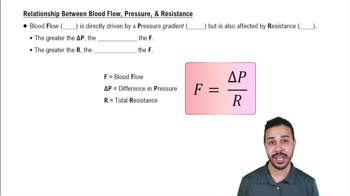
Relationship Between Blood Flow, Pressure, & Resistance

Vasomotion

Vasomotion refers to the rhythmic contraction and relaxation of precapillary sphincters and small blood vessels. This process causes intermittent blood flow through capillary beds, allowing fine-tuned local regulation of blood supply.

Autoregulation

Autoregulation is the ability of tissues to maintain a relatively constant blood flow despite changes in arterial pressure. It involves mechanisms like myogenic responses and metabolic factors but is broader than the specific action of precapillary sphincters.
Recommended video:
1:11
Renal Physiology: Regulation of Glomerular Filtration Example 1