Ch. 21 Blood Vessels and Circulation
Martini - Fundamentals of Anatomy and Physiology 12th Edition
Martini, Nath, Bartholomew12th EditionFundamentals of Anatomy and PhysiologyISBN: 9780137854011Not the one you use?Change textbook
Chapter 21, Problem 8

Blood is transported through the venous system by means of:
(a) Skeletal muscle contractions
(b) Decreasing blood pressure
(c) The respiratory pump
(d) A and C

Verified step by step guidance
1
Step 1: Understand the venous system's function, which is to return deoxygenated blood back to the heart, often against gravity, especially from the lower parts of the body.
Step 2: Recognize that veins have valves to prevent backflow, but they rely on external mechanisms to help push blood toward the heart since the pressure in veins is relatively low compared to arteries.
Step 3: Identify the role of skeletal muscle contractions (option a) in compressing veins during movement, which helps propel blood forward through the valves—this is often called the 'muscle pump.'
Step 4: Understand the respiratory pump (option c), which involves pressure changes in the thoracic cavity during breathing that help draw blood into the thoracic veins and the right atrium.
Step 5: Evaluate the options: decreasing blood pressure (option b) does not directly aid venous return; instead, the combination of skeletal muscle contractions and the respiratory pump (option d) effectively assists venous blood flow.

Verified video answer for a similar problem:

This video solution was recommended by our tutors as helpful for the problem above.
Was this helpful?

Key Concepts

Here are the essential concepts you must grasp in order to answer the question correctly.

Skeletal Muscle Contractions

Skeletal muscle contractions help propel blood through veins, especially in the limbs, by compressing the veins and pushing blood toward the heart. This mechanism is often called the 'muscle pump' and is crucial for venous return against gravity.
Recommended video:
Guided course
4:53
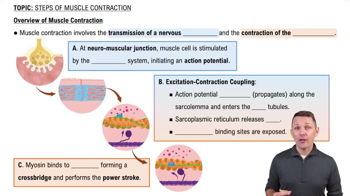
Overview of Muscle Contraction

The Respiratory Pump

The respiratory pump involves pressure changes in the thoracic cavity during breathing. When you inhale, decreased thoracic pressure and increased abdominal pressure help draw venous blood toward the heart, aiding venous return.
Recommended video:
03:40
The Sodium Potassium Pump

Venous Blood Pressure and Flow

Venous blood pressure is generally low and does not decrease to drive blood flow; instead, mechanisms like muscle contractions and the respiratory pump assist venous return. Understanding that decreasing blood pressure alone does not transport venous blood is key.
Recommended video:
6:40
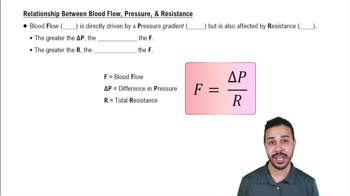
Relationship Between Blood Flow, Pressure, & Resistance