Ch. 2 The Chemical Level of Organization
Martini - Fundamentals of Anatomy and Physiology 12th Edition
Martini, Nath, Bartholomew12th EditionFundamentals of Anatomy and PhysiologyISBN: 9780137854011Not the one you use?Change textbook
Chapter 2, Problem 1b

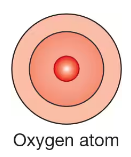
An oxygen atom has eight protons.
(b) How many more electrons will it take to fill the outermost energy level?

Verified step by step guidance
1
Step 1: Identify the number of electrons in a neutral oxygen atom. Since oxygen has 8 protons, it also has 8 electrons to balance the charge.
Step 2: Understand the electron shell configuration. The first energy level (closest to the nucleus) can hold up to 2 electrons, and the second energy level can hold up to 8 electrons.
Step 3: Determine how many electrons are in each energy level for oxygen. The first shell will be full with 2 electrons, and the remaining electrons will be in the second shell.
Step 4: Calculate how many electrons are currently in the outermost (second) energy level by subtracting the electrons in the first shell from the total electrons.
Step 5: Find how many more electrons are needed to fill the outermost shell by subtracting the current number of electrons in the second shell from the maximum capacity of 8 electrons.

Verified video answer for a similar problem:

This video solution was recommended by our tutors as helpful for the problem above.
Video duration:
1m
Was this helpful?

Key Concepts

Here are the essential concepts you must grasp in order to answer the question correctly.

Atomic Structure

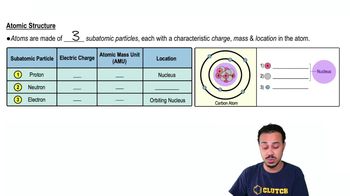
An atom consists of a nucleus containing protons and neutrons, surrounded by electrons in energy levels or shells. The number of protons defines the element, while electrons occupy shells around the nucleus. For oxygen, there are 8 protons and typically 8 electrons.
Recommended video:
04:48
Atomic Structure

Electron Energy Levels and Shell Capacity

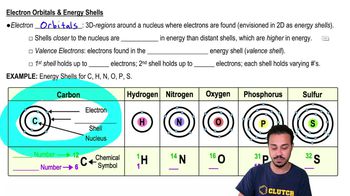
Electrons occupy energy levels or shells around the nucleus, each with a maximum capacity. The first shell can hold up to 2 electrons, and the second shell can hold up to 8 electrons. Electrons fill the innermost shells first before occupying outer shells.
Recommended video:
09:44
Electron Orbitals & Energy Shells

Valence Electrons and Shell Completion

The outermost shell of an atom is called the valence shell, which determines chemical properties. Atoms tend to fill their valence shell to achieve stability, often by gaining, losing, or sharing electrons. For oxygen, the valence shell can hold 8 electrons, but it initially has 6, so it needs 2 more to be full.
Recommended video:
09:44
Electron Orbitals & Energy Shells