Phil is stung on his cheek by a wasp. Because Phil is allergic to wasp venom, his throat begins to swell and his respiratory passages constrict. Would acetylcholine or epinephrine be more helpful in relieving his condition? Why?
Ch. 16 The Autonomic Nervous System and Higher-Order Functions

Martini, Nath, Bartholomew12th EditionFundamentals of Anatomy and PhysiologyISBN: 9780137854011Not the one you use?Change textbook
All textbooks
Martini, Nath, Bartholomew 12th Edition
Ch. 16 The Autonomic Nervous System and Higher-Order Functions
Problem 29
Martini, Nath, Bartholomew 12th Edition
Ch. 16 The Autonomic Nervous System and Higher-Order Functions
Problem 29Chapter 16, Problem 29
The condition known as shock is characterized in part by a decreased return of venous blood to the heart. How could an upsetting situation, such as the sight of a tragic accident or very bad news, produce some temporary symptoms of shock?
Verified step by step guidance1
Step 1: Understand that the sight of a tragic accident or very bad news can trigger the body's 'fight or flight' response, which is controlled by the sympathetic nervous system.
Step 2: Recognize that this sympathetic activation causes the release of stress hormones like adrenaline (epinephrine), which lead to vasoconstriction (narrowing of blood vessels) in certain areas of the body.
Step 3: Note that vasoconstriction in the veins reduces their capacity to hold blood, which can decrease venous return—the amount of blood flowing back to the heart.
Step 4: Understand that decreased venous return means less blood fills the heart during diastole, reducing stroke volume and cardiac output temporarily.
Step 5: Connect these physiological changes to the symptoms of shock, such as dizziness, weakness, or fainting, which can occur temporarily due to reduced blood flow to vital organs including the brain.

Verified video answer for a similar problem:
This video solution was recommended by our tutors as helpful for the problem above.
Was this helpful?
Key Concepts
Here are the essential concepts you must grasp in order to answer the question correctly.
Venous Return and Cardiac Output
Venous return is the flow of blood back to the heart, which directly affects cardiac output—the amount of blood the heart pumps per minute. A decrease in venous return reduces cardiac output, leading to insufficient blood flow to organs and tissues, a key feature of shock.
Recommended video:
Guided course
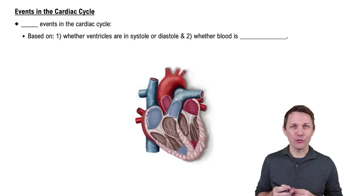
Events in the Cardiac Cycle
Sympathetic Nervous System Activation
An upsetting situation triggers the sympathetic nervous system, causing the release of stress hormones like adrenaline. This response can lead to vasoconstriction and increased heart rate, but in some cases, it may also cause blood to pool in certain areas, temporarily reducing venous return.
Recommended video:
Sympathetic Nervous System Example 1
Psychogenic (Emotional) Shock
Psychogenic shock occurs when emotional stress causes a sudden drop in blood pressure and heart rate due to nervous system reflexes. This can reduce venous return and mimic physical shock symptoms, such as dizziness or fainting, even without actual blood loss or injury.
Recommended video:
Control of the ANS Example 2
Related Practice
Textbook Question
9
views
Textbook Question
While studying the activity of smooth muscle in blood vessels, Shelly discovers that, when applied to a muscle plasma membrane, a molecule chemically similar to a neurotransmitter triggers an increase in intracellular calcium ions. Which neurotransmitter is the molecule mimicking, and to which receptors is it binding?
1
views
Textbook Question
Nicotine stimulates cholinergic receptors of the ANS. Based on this information, how would cigarette smoking affect the cardiovascular system?
1
views
Textbook Question
You are home alone at night when you hear what sounds like breaking glass. What physiological effects would this experience probably produce, and what would be their cause?
1
views
Textbook Question
Why is autonomic tone a significant part of ANS function?
1
views