Ch. 16 The Autonomic Nervous System and Higher-Order Functions
Martini - Fundamentals of Anatomy and Physiology 12th Edition
Martini, Nath, Bartholomew12th EditionFundamentals of Anatomy and PhysiologyISBN: 9780137854011Not the one you use?Change textbook
Chapter 16, Problem 28

Nicotine stimulates cholinergic receptors of the ANS. Based on this information, how would cigarette smoking affect the cardiovascular system?

Verified step by step guidance
1
Step 1: Understand that nicotine acts as an agonist at cholinergic receptors, specifically nicotinic receptors, which are part of the autonomic nervous system (ANS). These receptors are found in both the sympathetic and parasympathetic ganglia.
Step 2: Recognize that stimulation of nicotinic receptors in the sympathetic ganglia leads to increased sympathetic nervous system activity, which generally results in effects such as increased heart rate and vasoconstriction.
Step 3: Consider that increased sympathetic activity causes the release of norepinephrine, which binds to adrenergic receptors on the heart and blood vessels, leading to increased cardiac output and elevated blood pressure.
Step 4: Analyze how these cardiovascular changes—such as increased heart rate (tachycardia) and vasoconstriction—can increase the workload on the heart and raise systemic vascular resistance.
Step 5: Summarize that cigarette smoking, through nicotine's stimulation of cholinergic receptors in the ANS, primarily enhances sympathetic activity, thereby increasing heart rate and blood pressure, which can contribute to cardiovascular stress.

Verified video answer for a similar problem:

This video solution was recommended by our tutors as helpful for the problem above.
Was this helpful?

Key Concepts

Here are the essential concepts you must grasp in order to answer the question correctly.

Cholinergic Receptors in the Autonomic Nervous System

Cholinergic receptors respond to the neurotransmitter acetylcholine and are found in both the sympathetic and parasympathetic branches of the ANS. Nicotine acts as an agonist, stimulating these receptors, which can alter autonomic regulation of various organs, including the heart and blood vessels.
Recommended video:
1:50
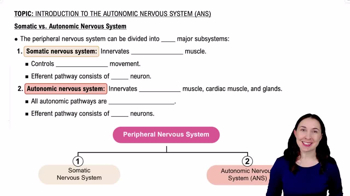
Somatic vs. Autonomic Nervous System

Effects of Nicotine on the Cardiovascular System

Nicotine stimulates the release of catecholamines like adrenaline, leading to increased heart rate, blood pressure, and vasoconstriction. These changes strain the cardiovascular system, increasing the risk of hypertension, atherosclerosis, and other heart-related conditions.
Recommended video:
1:32
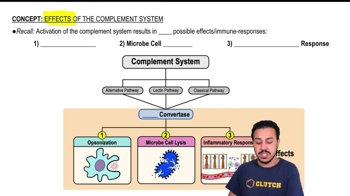
Effects of the Complement System

Autonomic Nervous System Regulation of Cardiovascular Function

The ANS controls heart rate, contractility, and vascular tone through sympathetic and parasympathetic inputs. Stimulation of cholinergic receptors by nicotine disrupts this balance, often enhancing sympathetic activity, which results in cardiovascular effects such as elevated heart rate and blood pressure.
Recommended video:
1:50
Somatic vs. Autonomic Nervous System