Textbook Question
The division of the ANS that prepares the body for activity and stress is the_____division.
(a) sympathetic
(b) parasympathetic
(c) craniosacral
(d) intramural
(e) somatomotor

 Martini, Nath, Bartholomew 12th EditionCh. 16 The Autonomic Nervous System and Higher-Order FunctionsProblem 4
 Verified step by step guidance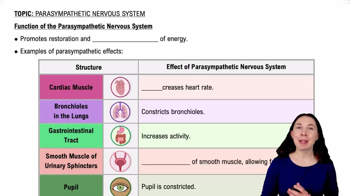
 1:56
1:56
 1:32
1:32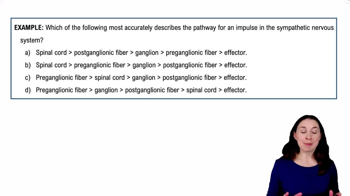 1:21
1:21The division of the ANS that prepares the body for activity and stress is the_____division.
(a) sympathetic
(b) parasympathetic
(c) craniosacral
(d) intramural
(e) somatomotor
The autonomic division of the nervous system directs
(a) Voluntary motor activity
(b) Conscious control of skeletal muscles
(c) Unconscious control of skeletal muscles
(d) Processes that maintain homeostasis
(e) Sensory input from the skin
A progressive disorder characterized by the loss of higher-order cerebral functions is
(a) Parkinson's disease
(b) Parasomnia
(c) Huntington's disease
(d) Alzheimer's disease
Which four ganglia serve as origins for postganglionic fibers involved in control of visceral structures in the head?
Starting in the spinal cord, trace an action potential through the sympathetic division of the ANS until it reaches a target organ in the abdominopelvic region.
The preganglionic and ganglionic neurons are missing from the diagram below showing the distribution of sympathetic innervation. Indicate their distribution using red for the preganglionic neurons and black for the ganglionic neurons.