Ch. 13 The Spinal Cord, Spinal Nerves, and Spinal Reflexes
Martini - Fundamentals of Anatomy and Physiology 12th Edition
Martini, Nath, Bartholomew12th EditionFundamentals of Anatomy and PhysiologyISBN: 9780137854011Not the one you use?Change textbook
Chapter 13, Problem 2

The anterior roots of each spinal segment
(a) Bring sensory information into the spinal cord
(b) Control peripheral effectors
(c) Contain the axons of somatic motor and visceral motor neurons
(d) Do both b and c

Verified step by step guidance
1
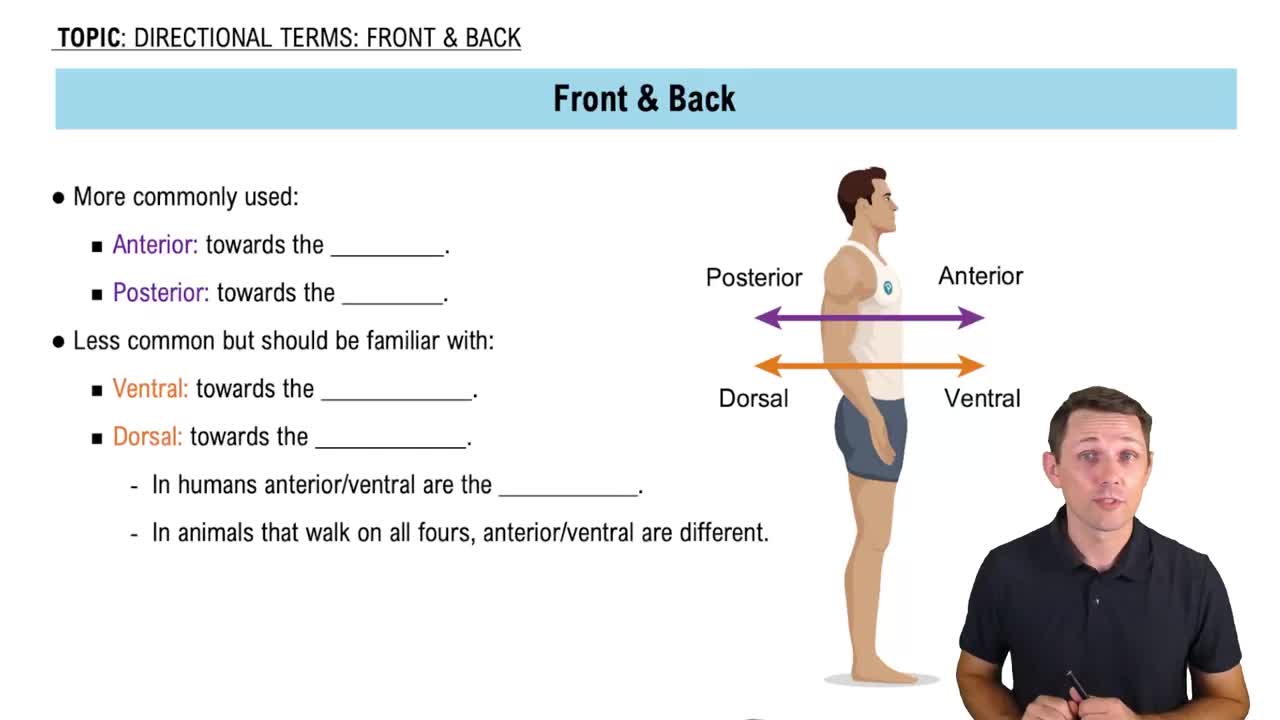
Step 1: Understand the structure of spinal nerves. Each spinal nerve is formed by the combination of two roots: the anterior (ventral) root and the posterior (dorsal) root.
Step 2: Recall the function of the posterior root. The posterior root contains sensory (afferent) fibers that bring sensory information from the peripheral receptors into the spinal cord.
Step 3: Recall the function of the anterior root. The anterior root contains motor (efferent) fibers that carry signals from the spinal cord to peripheral effectors such as muscles and glands.
Step 4: Recognize that the anterior root contains axons of both somatic motor neurons (which control skeletal muscles) and visceral motor neurons (which control smooth muscle, cardiac muscle, and glands).
Step 5: Based on these points, conclude that the anterior roots do not bring sensory information in, but they do control peripheral effectors and contain axons of both somatic and visceral motor neurons, which corresponds to option (d).

Verified video answer for a similar problem:

This video solution was recommended by our tutors as helpful for the problem above.
Was this helpful?

Key Concepts

Here are the essential concepts you must grasp in order to answer the question correctly.

Anterior Roots of Spinal Nerves

The anterior roots of spinal nerves consist primarily of motor neuron axons that exit the spinal cord to innervate muscles and glands. They carry motor commands from the central nervous system to peripheral effectors, enabling movement and autonomic functions.
Recommended video:
Guided course
02:31
Anterior and Posterior

Sensory vs. Motor Pathways

Sensory information enters the spinal cord through the posterior (dorsal) roots, not the anterior roots. Understanding this distinction is crucial for identifying the direction of nerve signal transmission in spinal segments.
Recommended video:
1:06
Organization of Sensory Pathways Example 1

Somatic and Visceral Motor Neurons

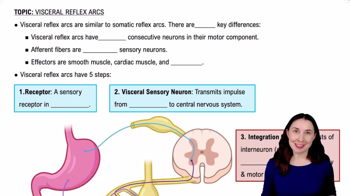
Somatic motor neurons control voluntary muscles, while visceral motor neurons regulate involuntary functions like gland secretion and smooth muscle activity. Both types of motor neurons send their axons through the anterior roots to reach their targets.
Recommended video:
2:12
Visceral Reflex Arcs