Ch. 13 The Spinal Cord, Spinal Nerves, and Spinal Reflexes
Martini - Fundamentals of Anatomy and Physiology 12th Edition
Martini, Nath, Bartholomew12th EditionFundamentals of Anatomy and PhysiologyISBN: 9780137854011Not the one you use?Change textbook
Chapter 13, Problem 3

Spinal nerves are called mixed nerves because they
(a) Contain sensory and motor fibers
(b) Exit at intervertebral foramina
(c) Are associated with a pair of spinal ganglia
(d) Are associated with posterior and anterior roots

Verified step by step guidance
1
Understand the term 'mixed nerves' in the context of spinal nerves. Mixed nerves are those that carry both sensory (afferent) and motor (efferent) fibers.
Recall the anatomy of spinal nerves: they arise from the spinal cord and contain fibers from both the dorsal (posterior) root, which carries sensory information, and the ventral (anterior) root, which carries motor information.
Analyze each option: (a) states that spinal nerves contain sensory and motor fibers, which aligns with the definition of mixed nerves.
(b) mentions the exit point of spinal nerves (intervertebral foramina), which is true but does not define why they are called mixed nerves.
(c) refers to spinal ganglia, which are associated with sensory neurons but do not explain the mixed nature of the nerve.
(d) mentions association with posterior and anterior roots, which is related to their structure but the key reason they are mixed nerves is the presence of both sensory and motor fibers.

Verified video answer for a similar problem:

This video solution was recommended by our tutors as helpful for the problem above.
Was this helpful?

Key Concepts

Here are the essential concepts you must grasp in order to answer the question correctly.

Mixed Nerves

Mixed nerves contain both sensory (afferent) and motor (efferent) fibers, allowing them to transmit signals to and from the central nervous system. This dual function enables coordination of sensory input and motor output within the same nerve.
Recommended video:
Guided course
2:25
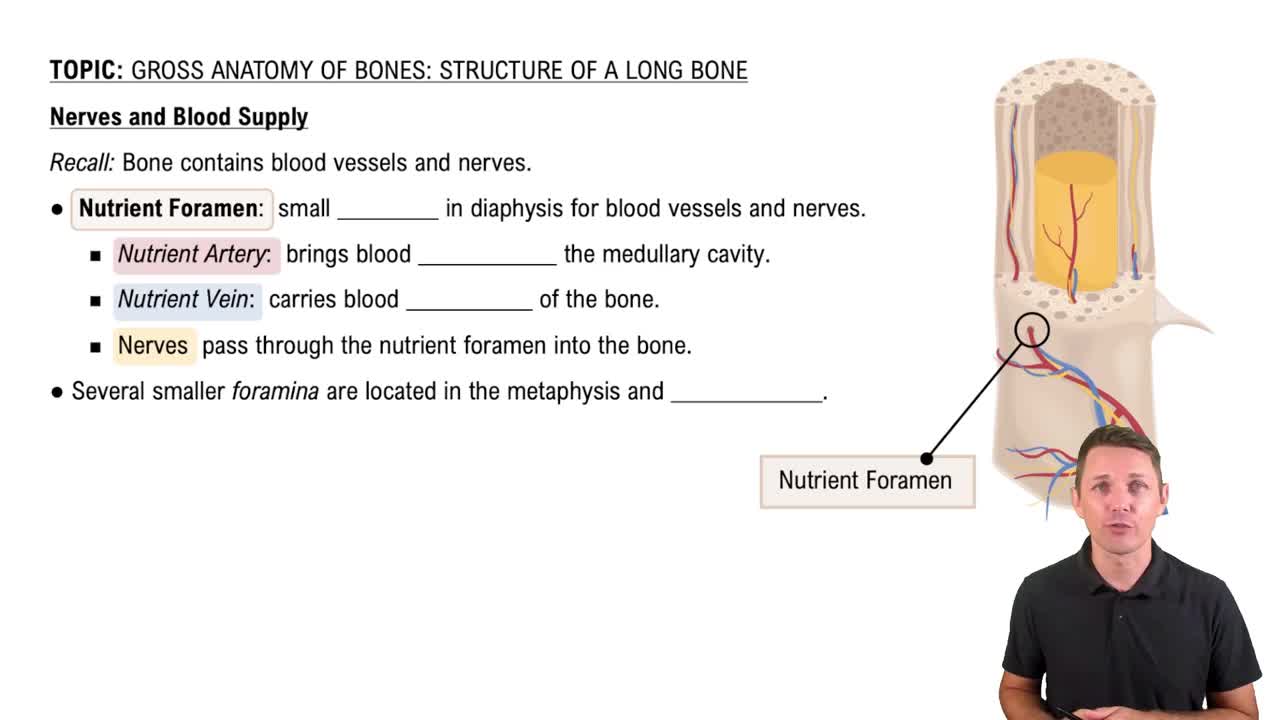
Nerves and Blood Supply

Spinal Nerve Anatomy

Spinal nerves emerge from the spinal cord through intervertebral foramina and are formed by the union of dorsal (sensory) and ventral (motor) roots. This anatomical structure is essential for their mixed function.
Recommended video:
Guided course
2:25
Nerves and Blood Supply

Spinal Ganglia and Roots

Spinal ganglia (dorsal root ganglia) contain the cell bodies of sensory neurons, while anterior (ventral) roots carry motor fibers. The association of these roots and ganglia explains the mixed nature of spinal nerves.
Recommended video:
1:21
Sympathetic Nervous System Example 3