Ch. 13 The Spinal Cord, Spinal Nerves, and Spinal Reflexes
Martini - Fundamentals of Anatomy and Physiology 12th Edition
Martini, Nath, Bartholomew12th EditionFundamentals of Anatomy and PhysiologyISBN: 9780137854011Not the one you use?Change textbook
Chapter 13, Problem 25

Side-to-side movements of the spinal cord are prevented by the:
(a) Filum terminale
(b) Denticulate ligaments
(c) Dura mater
(d) Pia mater
(e) Arachnoid mater

Verified step by step guidance
1
Step 1: Understand the anatomy of the spinal cord and its protective structures. The spinal cord is surrounded by three meningeal layers: dura mater (outermost), arachnoid mater (middle), and pia mater (innermost). Additionally, there are specialized structures that help stabilize the spinal cord within the vertebral canal.
Step 2: Identify the role of the filum terminale. The filum terminale is a fibrous extension of the pia mater that anchors the spinal cord to the coccyx, preventing vertical movement but not primarily side-to-side movement.
Step 3: Examine the denticulate ligaments. These are lateral extensions of the pia mater that attach to the dura mater at intervals along the spinal cord. Their function is to anchor the spinal cord laterally, preventing side-to-side displacement.
Step 4: Consider the dura mater, pia mater, and arachnoid mater individually. While these layers protect and enclose the spinal cord, they do not specifically prevent side-to-side movement by themselves; rather, the denticulate ligaments, which are part of the pia mater, perform this function.
Step 5: Conclude that the structure responsible for preventing side-to-side movements of the spinal cord is the denticulate ligaments, as they provide lateral stabilization by anchoring the spinal cord to the dura mater.

Verified video answer for a similar problem:

This video solution was recommended by our tutors as helpful for the problem above.
Was this helpful?

Key Concepts

Here are the essential concepts you must grasp in order to answer the question correctly.

Denticulate Ligaments

Denticulate ligaments are lateral extensions of the pia mater that anchor the spinal cord to the dura mater. They prevent excessive side-to-side movement by stabilizing the spinal cord within the vertebral canal, ensuring it remains centered and protected.
Recommended video:
3:43
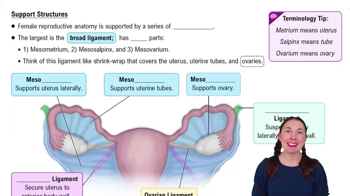
Support Structures

Filum Terminale

The filum terminale is a fibrous extension of the pia mater that anchors the spinal cord inferiorly to the coccyx. It primarily prevents vertical displacement rather than lateral movement of the spinal cord.

Meninges of the Spinal Cord

The spinal cord is surrounded by three meninges: dura mater (outer tough layer), arachnoid mater (middle web-like layer), and pia mater (inner delicate layer). These layers protect and support the spinal cord, with the pia mater closely adhering to it and forming structures like denticulate ligaments.
Recommended video:
2:14
Sympathetic Nervous System Example 4