Ch. 13 The Spinal Cord, Spinal Nerves, and Spinal Reflexes
Martini - Fundamentals of Anatomy and Physiology 12th Edition
Martini, Nath, Bartholomew12th EditionFundamentals of Anatomy and PhysiologyISBN: 9780137854011Not the one you use?Change textbook
Chapter 13, Problem 28

Mary complains that when she wakes up in the morning, her thumb and forefinger are always “asleep.” She mentions this condition to her physician, who asks Mary whether she sleeps with her wrists flexed. She replies that she does. The physician tells Mary that sleeping in that position may compress a portion of one of her peripheral nerves, producing her symptoms. Which nerve is involved?

Verified step by step guidance
1
Step 1: Identify the symptoms described by Mary—numbness or 'asleep' sensation in the thumb and forefinger upon waking up. This suggests involvement of sensory nerves supplying these areas.
Step 2: Recall the anatomy of the peripheral nerves in the upper limb, focusing on which nerve provides sensation to the thumb and forefinger. The median nerve is primarily responsible for sensation in these digits.
Step 3: Understand the effect of wrist position on nerve compression. Flexing the wrist can compress the median nerve as it passes through the carpal tunnel, a narrow passageway in the wrist.
Step 4: Connect the symptoms and wrist position to a common condition called carpal tunnel syndrome, where the median nerve is compressed, causing numbness and tingling in the thumb, index, and middle fingers.
Step 5: Conclude that the nerve involved in Mary's symptoms is the median nerve, which is susceptible to compression during wrist flexion, especially during sleep.

Verified video answer for a similar problem:

This video solution was recommended by our tutors as helpful for the problem above.
Was this helpful?

Key Concepts

Here are the essential concepts you must grasp in order to answer the question correctly.

Peripheral Nerve Compression

Peripheral nerve compression occurs when a nerve is pressed or squeezed by surrounding tissues, leading to symptoms like numbness, tingling, or weakness. In the context of wrist flexion during sleep, certain nerves can be compressed, causing sensory disturbances in the hand.
Recommended video:
3:33
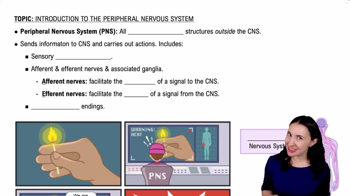
Peripheral Nervous System

Median Nerve Anatomy and Function

The median nerve runs through the carpal tunnel at the wrist and provides sensation to the thumb, index, middle finger, and part of the ring finger. Compression of this nerve, especially during wrist flexion, can cause numbness or 'asleep' sensations in these fingers.
Recommended video:
Guided course
2:25
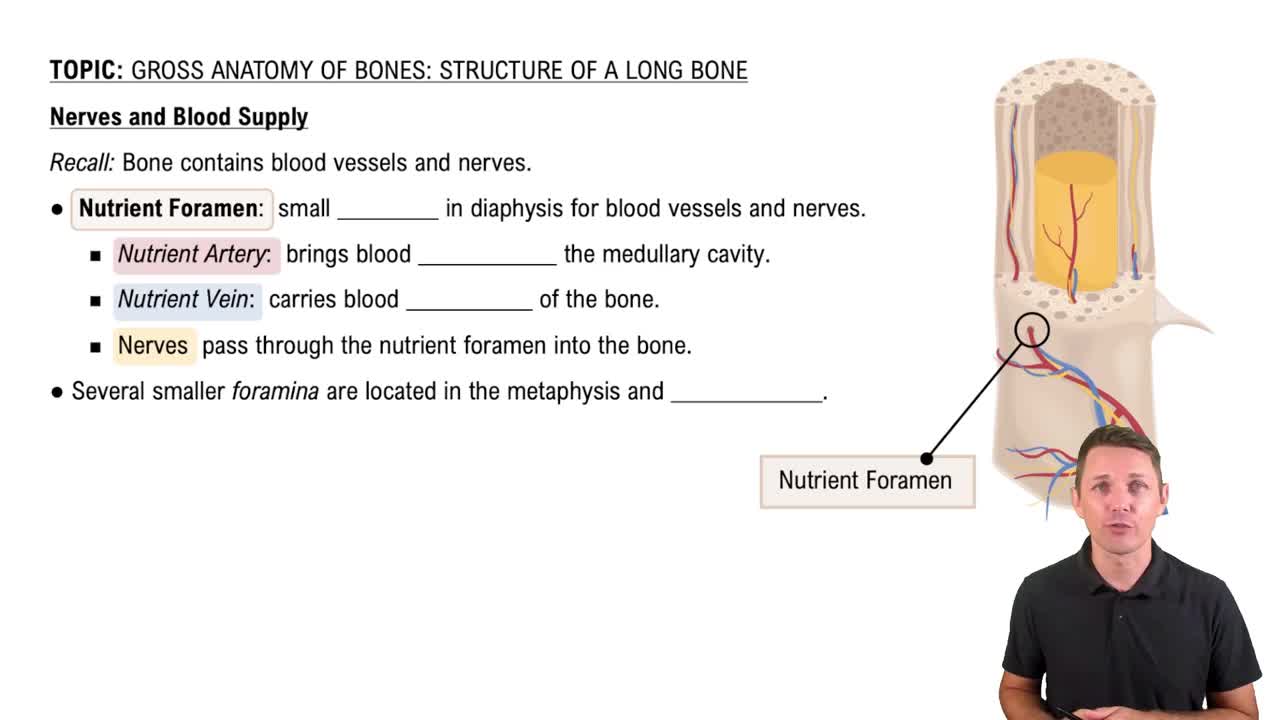
Nerves and Blood Supply

Carpal Tunnel Syndrome

Carpal tunnel syndrome is a common condition caused by median nerve compression within the carpal tunnel, often worsened by wrist flexion. It typically presents with numbness, tingling, and sometimes pain in the thumb, index, and middle fingers, especially noticeable upon waking.
Recommended video:
Guided course
01:52
Anatomical Terms for the Leg and Foot Example 2