
Textbook Question
What are fluid shifts? What is their function, and what factors can cause them?
1
views

 Verified step by step guidance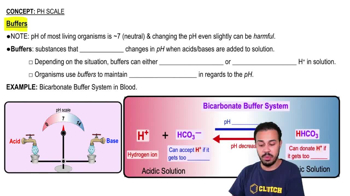
 05:38
05:38
 7:52
7:52 06:07
06:07What are fluid shifts? What is their function, and what factors can cause them?
Why should a person with a fever drink plenty of fluids?
Drinking a solution hypotonic to the ECF causes the ECF to:
(a) Increase in volume and become hypertonic to the ICF
(b) Decrease in volume and become hypertonic to the ICF
(c) Decrease in volume and become hypotonic to the ICF
(d) Increase in volume and become hypotonic to the ICF
The osmotic concentration of the ECF decreases if an individual gains water without a corresponding:
(a) Gain of electrolytes
(b) Loss of water
(c) Fluid shift from the ECF to the ICF
(d) All of these
When the pH of body fluids begins to decrease, free amino acids and proteins will
(a) Release a hydrogen from the carboxyl group
(b) Release a hydrogen from the amino group
(c) Release a hydrogen at the carboxyl group
(d) Bind a hydrogen at the amino group
Define and give an example of:
(a) A volatile acid
(b) A fixed acid, and
(c) A metabolic acid
Which represents the greatest threat to acid-base balance? Why?