Ch. 27 Fluids & Electrolytes
Martini - Fundamentals of Anatomy & Physiology 11th Edition
Martini, Nath, Bartholomew11th EditionFundamentals of Anatomy & PhysiologyISBN: 9780136874089Not the one you use?Change textbook
Chapter 26, Problem 18

Define and give an example of:
(a) A volatile acid
(b) A fixed acid, and 
(c) A metabolic acid
Which represents the greatest threat to acid-base balance? Why?

Verified step by step guidance
1
Step 1: Define a volatile acid. A volatile acid is an acid that can be eliminated from the body by the lungs through exhalation. The primary example is carbonic acid (H2CO3), which forms from carbon dioxide (CO2) dissolved in blood and can be converted back to CO2 and water for removal via respiration.
Step 2: Define a fixed acid. A fixed acid is an acid that cannot be exhaled and must be eliminated by the kidneys. These acids remain in the body fluids until they are buffered or excreted. An example of a fixed acid is sulfuric acid (H2SO4), which is produced from the metabolism of sulfur-containing amino acids.
Step 3: Define a metabolic acid. Metabolic acids are acids produced during normal metabolic processes, including both volatile and fixed acids. They include acids generated from metabolism such as lactic acid (from anaerobic respiration) and ketoacids (from fat metabolism).
Step 4: Compare the threat each acid type poses to acid-base balance. Fixed acids represent the greatest threat because they cannot be removed by the lungs and must be buffered and excreted by the kidneys, which is a slower process. Accumulation of fixed acids can lead to metabolic acidosis if not properly managed.
Step 5: Summarize why fixed acids are more challenging. Since volatile acids like carbonic acid can be rapidly eliminated by breathing, they are less likely to cause prolonged acid-base imbalance. Fixed acids require renal function for removal, so any impairment in kidney function or excessive production can disrupt acid-base homeostasis more severely.

Verified video answer for a similar problem:

This video solution was recommended by our tutors as helpful for the problem above.
Was this helpful?

Key Concepts

Here are the essential concepts you must grasp in order to answer the question correctly.

Volatile Acid

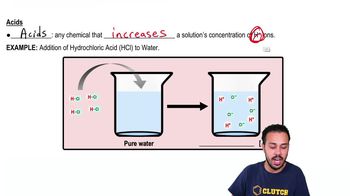
Volatile acids are acids that can be converted to a gaseous form and eliminated through the lungs, primarily carbonic acid (H2CO3), which dissociates into CO2 and water. The body regulates these acids by controlling respiration rate to maintain acid-base balance. An example is carbonic acid formed from CO2 in the blood.
Recommended video:
02:45
Acids

Fixed Acid

Fixed acids are non-volatile acids that cannot be exhaled and must be eliminated by the kidneys. These acids, such as sulfuric acid and phosphoric acid, result from metabolism of proteins and other substances. They accumulate in the body if renal function is impaired, affecting acid-base homeostasis.
Recommended video:
02:45
Acids

Metabolic Acid and Its Threat to Acid-Base Balance

Metabolic acids include fixed acids and other acids produced during metabolism, like lactic acid. They pose the greatest threat to acid-base balance because they cannot be removed by the lungs and rely on renal excretion. Accumulation leads to metabolic acidosis, disrupting physiological functions and requiring compensatory mechanisms.
Recommended video:
01:29
Acids and Bases