Ch. 10 Muscle Tissue
Martini - Fundamentals of Anatomy & Physiology 11th Edition
Martini, Nath, Bartholomew11th EditionFundamentals of Anatomy & PhysiologyISBN: 9780136874089Not the one you use?Change textbook
Chapter 10, Problem 22

For each portion of a myogram tracing a twitch in a stimulated calf muscle fiber, describe the events that occur within the muscle fiber.

Verified step by step guidance
1
Identify the three main phases of a muscle twitch as shown on a myogram: the latent period, the contraction phase, and the relaxation phase.
During the latent period, explain that the muscle fiber is preparing to contract; this includes the action potential traveling along the sarcolemma and down the T-tubules, leading to calcium ion release from the sarcoplasmic reticulum.
In the contraction phase, describe how calcium ions bind to troponin, causing tropomyosin to move and expose the active sites on actin filaments, allowing cross-bridge cycling between actin and myosin, which generates tension and shortens the muscle fiber.
During the relaxation phase, explain that calcium ions are actively pumped back into the sarcoplasmic reticulum, tropomyosin covers the active sites on actin again, cross-bridge cycling stops, and the muscle fiber returns to its resting length as tension decreases.
Summarize that the myogram tracing reflects these internal events: the latent period corresponds to excitation-contraction coupling, the contraction phase corresponds to cross-bridge activity and tension development, and the relaxation phase corresponds to calcium reuptake and muscle fiber relaxation.

Verified video answer for a similar problem:

This video solution was recommended by our tutors as helpful for the problem above.
Video duration:
3m
Was this helpful?

Key Concepts

Here are the essential concepts you must grasp in order to answer the question correctly.

Phases of a Muscle Twitch

A muscle twitch consists of three phases: the latent period, contraction phase, and relaxation phase. The latent period is the brief delay after stimulation before contraction begins. During contraction, the muscle fibers shorten as tension increases. In relaxation, the muscle returns to its resting state as tension decreases.
Recommended video:
03:21
Phases of Mitosis

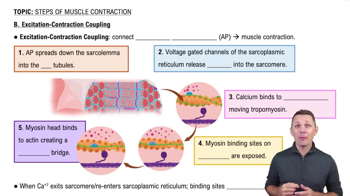
Excitation-Contraction Coupling

Excitation-contraction coupling is the process linking muscle fiber stimulation to contraction. It involves the generation of an action potential, release of calcium ions from the sarcoplasmic reticulum, and the interaction of actin and myosin filaments that produce muscle tension.
Recommended video:
Guided course
5:47
B. Excitation-Contraction Coupling

Role of Calcium Ions in Muscle Contraction

Calcium ions released into the cytoplasm bind to troponin, causing a conformational change that moves tropomyosin away from actin's binding sites. This allows myosin heads to attach to actin, forming cross-bridges and enabling contraction. When calcium is pumped back, the muscle relaxes.
Recommended video:
Guided course
4:27
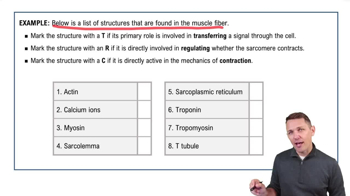
Steps of Muscle Contraction Example 1