Ch. 2 Chemistry Comes Alive
Marieb - Human Anatomy & Physiology 7th Edition
Marieb, Hoehn7th EditionHuman Anatomy & PhysiologyISBN: 9780805359091Not the one you use?Change textbook
Chapter 2, Problem 12b

Provide the atomic symbol for each of the following elements:
e. Nitrogen
f. Oxygen
g. Potassium
h. Sodium

Verified step by step guidance
1
Step 1: Understand that the atomic symbol for an element is a one- or two-letter abbreviation derived from its name or Latin name. It is used universally in chemistry and biology.
Step 2: Recall that the atomic symbol for nitrogen is 'N'. This is derived directly from the name 'nitrogen'.
Step 3: Recall that the atomic symbol for oxygen is 'O'. This is derived directly from the name 'oxygen'.
Step 4: Recall that the atomic symbol for potassium is 'K'. This comes from the Latin name 'kalium'.
Step 5: Recall that the atomic symbol for sodium is 'Na'. This comes from the Latin name 'natrium'.

Verified video answer for a similar problem:

This video solution was recommended by our tutors as helpful for the problem above.
Video duration:
1m
Was this helpful?

Key Concepts

Here are the essential concepts you must grasp in order to answer the question correctly.

Atomic Symbol

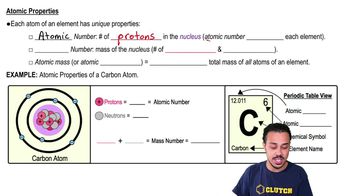
An atomic symbol is a one- or two-letter abbreviation used to represent a chemical element. The first letter is always capitalized, and if there is a second letter, it is lowercase. For example, the atomic symbol for nitrogen is 'N', while oxygen is represented as 'O'. These symbols are standardized and universally recognized in the field of chemistry.
Recommended video:
07:43
Atomic Properties

Periodic Table of Elements

The periodic table is a tabular arrangement of all known chemical elements, organized by increasing atomic number. Each element is represented by its atomic symbol, and the table provides information about the element's properties, such as atomic mass and group classification. Understanding the periodic table is essential for identifying elements and their symbols.
Recommended video:
06:26
Refractory Period

Element Classification

Elements are classified into categories such as metals, nonmetals, and metalloids based on their physical and chemical properties. For instance, nitrogen and oxygen are nonmetals, while potassium and sodium are alkali metals. This classification helps in predicting the behavior of elements in chemical reactions and understanding their roles in various applications.
Recommended video:
08:25
Structural Joint Classifications