Ch. 12 The Central Nervous System
Marieb - Human Anatomy & Physiology 7th Edition
Marieb, Hoehn7th EditionHuman Anatomy & PhysiologyISBN: 9780805359091Not the one you use?Change textbook
Chapter 12, Problem 30

Tara, a 16-year-old girl, was rushed to the hospital after taking a bad spill off the parallel bars. After she had a complete neurological workup, her family was told that she would be permanently paralyzed from the waist down. During rehabilitation, her neurologist outlined for Tara and her parents the importance of preventing complications in such cases. Common complications include urinary infection, bed sores, and muscular spasms. Using your knowledge of neuroanatomy, explain the underlying reasons for these complications.

Verified step by step guidance
1
Step 1: Understand the level and extent of spinal cord injury. Since Tara is paralyzed from the waist down, the injury likely involves the thoracic or lumbar spinal cord segments, which disrupts motor and sensory pathways below the injury site.
Step 2: Explain urinary infections. The spinal cord injury impairs autonomic control of the bladder, leading to urinary retention or incontinence. This causes incomplete emptying of the bladder, creating a breeding ground for bacteria and increasing the risk of urinary tract infections.
Step 3: Describe bed sores (pressure ulcers). Loss of sensation and immobility below the injury site means Tara cannot feel pressure or pain in affected areas. Prolonged pressure on skin over bony prominences reduces blood flow, causing tissue damage and ulcers.
Step 4: Discuss muscular spasms (spasticity). After spinal cord injury, the loss of inhibitory signals from the brain leads to hyperactive reflex arcs below the lesion. This results in involuntary muscle contractions or spasms.
Step 5: Summarize how these complications arise from disrupted neural pathways controlling autonomic functions, sensory feedback, and motor control, emphasizing the importance of careful management and rehabilitation.

Verified video answer for a similar problem:

This video solution was recommended by our tutors as helpful for the problem above.
Video duration:
2m
Was this helpful?

Key Concepts

Here are the essential concepts you must grasp in order to answer the question correctly.

Spinal Cord Injury and Paralysis

A spinal cord injury disrupts communication between the brain and body below the injury site, causing paralysis and loss of sensation. In Tara's case, damage likely occurred at or below the thoracic level, leading to paralysis from the waist down. This interruption affects motor control, sensory input, and autonomic functions, which underlie many secondary complications.
Recommended video:
0:56
Parasympathetic Nervous System Example 2

Neurogenic Bladder and Urinary Infections

Spinal cord injuries often impair bladder control by disrupting signals between the bladder and brain, resulting in neurogenic bladder. This causes incomplete emptying or retention of urine, creating a breeding ground for bacteria and increasing the risk of urinary tract infections. Proper management is essential to prevent these infections.
Recommended video:
2:57
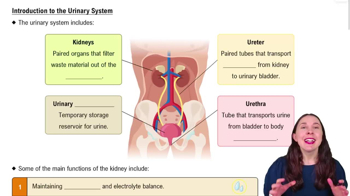
The Urinary System

Pressure Ulcers and Muscle Spasms

Immobility from paralysis leads to prolonged pressure on skin areas, reducing blood flow and causing bed sores or pressure ulcers. Additionally, loss of inhibitory signals from the brain can cause involuntary muscle spasms or spasticity. Both complications require careful monitoring and management during rehabilitation.
Recommended video:
3:18
Vascular Spasm