Ch. 12 The Central Nervous System
Marieb - Human Anatomy & Physiology 7th Edition
Marieb, Hoehn7th EditionHuman Anatomy & PhysiologyISBN: 9780805359091Not the one you use?Change textbook
Chapter 12, Problem 27

Describe the spinal cord, depicting its extent, its composition of gray and white matter, and its spinal roots.

Verified step by step guidance
1
Begin by describing the extent of the spinal cord: explain that it extends from the medulla oblongata at the base of the brain down through the vertebral canal, typically ending around the L1-L2 vertebral level in adults.
Next, discuss the composition of the spinal cord in terms of gray and white matter: describe that the gray matter is centrally located in an H-shaped or butterfly-shaped region, containing neuron cell bodies, while the white matter surrounds the gray matter and consists mainly of myelinated axons organized into tracts.
Explain the functional significance of gray and white matter: gray matter processes and integrates information, whereas white matter transmits signals up and down the spinal cord between the brain and peripheral nerves.
Describe the spinal roots: explain that each spinal nerve arises from two roots— the dorsal (posterior) root, which carries sensory (afferent) fibers into the spinal cord, and the ventral (anterior) root, which carries motor (efferent) fibers out to the muscles.
Finally, mention how the dorsal and ventral roots merge to form a mixed spinal nerve that exits the vertebral column through the intervertebral foramina, facilitating communication between the central nervous system and the rest of the body.

Verified video answer for a similar problem:

This video solution was recommended by our tutors as helpful for the problem above.
Video duration:
1m
Was this helpful?

Key Concepts

Here are the essential concepts you must grasp in order to answer the question correctly.

Extent of the Spinal Cord

The spinal cord extends from the medulla oblongata at the base of the brain down to the level of the first or second lumbar vertebra. It is protected by the vertebral column and is divided into cervical, thoracic, lumbar, sacral, and coccygeal regions, corresponding to different spinal nerves.
Recommended video:
2:14
Sympathetic Nervous System Example 4

Gray and White Matter Composition

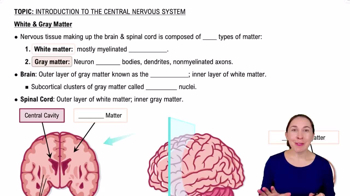
The spinal cord consists of an inner core of gray matter shaped like a butterfly, containing neuron cell bodies, and an outer layer of white matter made up of myelinated axons. Gray matter processes information, while white matter transmits signals between the brain and the body.
Recommended video:
2:41
White & Gray Matter

Spinal Roots

Spinal roots are bundles of nerve fibers that emerge from the spinal cord. The dorsal (posterior) roots carry sensory information into the spinal cord, while the ventral (anterior) roots carry motor commands out to muscles. Together, they form spinal nerves that innervate the body.
Recommended video:
7:55
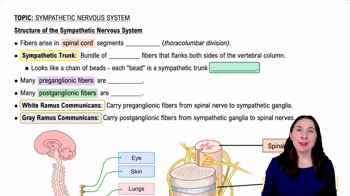
Structure of the Sympathetic Nervous System
Related Practice
Textbook Question

a. Define cerebrovascular accident or CVA.

b. Describe its possible causes and consequences.

1
views
Textbook Question

Tara, a 16-year-old girl, was rushed to the hospital after taking a bad spill off the parallel bars. After she had a complete neurological workup, her family was told that she would be permanently paralyzed from the waist down. During rehabilitation, her neurologist outlined for Tara and her parents the importance of preventing complications in such cases. Common complications include urinary infection, bed sores, and muscular spasms. Using your knowledge of neuroanatomy, explain the underlying reasons for these complications.

1
views
Textbook Question

Mrs. Jones has had a progressive decline in her mental capabilities in the last five or six years. At first her family attributed her occasional memory lapses, confusion, and agitation to grief over her husband's death six years earlier. When examined, Mrs. Jones was aware of her cognitive problems and was shown to have an IQ score approximately 30 points less than would be predicted by her work history. A CT scan showed diffuse cerebral atrophy. The physician prescribed an acetylcholinesterase inhibitor and Mrs. Jones showed slight improvement. What is Mrs. Jones's problem? Why did the acetylcholinesterase inhibitor help?

3
views
Textbook Question

Robert, a brilliant computer analyst, suffered a blow to his anterior skull from a falling rock while mountain climbing. Shortly thereafter, it was obvious to his coworkers that his behavior had undergone a dramatic change. Although previously a smart dresser, he was now unkempt. One morning, he was observed defecating into the wastebasket. Which region of Robert's brain was affected by the cranial blow?

1
views
Textbook Question

What does lateralization of cortical functioning mean?

Why is the term cerebral dominance a misnomer?

2
views
Textbook Question

A 10-month-old infant has an enlarging head circumference and delayed overall development. Her CSF pressure is elevated, and she has a bulging anterior fontanelle (fontanelles are the as yet unossified fibrous membranes connecting skull bones in infants). Based on these findings, answer the following questions:

a. What are the possible cause(s) of an enlarged head?

b. Which tests might be helpful in obtaining information about this infant's problem?

c. Assuming the tests conducted showed the cerebral aqueduct to be constricted, which ventricles or CSF-containing areas would you expect to be enlarged? Which would likely not be visible? Respond to the same questions based on a finding of obstructed arachnoid granulations.