Provide one example for each way endocrine glands are stimulated to release their hormones.
Ch. 9 The Endocrine System

Marieb13th EditionEssentials of Human Anatomy & PhysiologyISBN: 9780135624340Not the one you use?Change textbook
Chapter 9, Problem 15
Name two endocrine-producing glands (or regions) that are important in the stress response, and explain why they are important.
Verified step by step guidance1
Identify the two primary endocrine-producing glands involved in the stress response: the adrenal glands and the hypothalamus.
Explain the role of the adrenal glands: The adrenal glands consist of two regions, the adrenal medulla and the adrenal cortex. The adrenal medulla releases catecholamines (epinephrine and norepinephrine) during the 'fight or flight' response, while the adrenal cortex produces glucocorticoids (like cortisol) that help regulate metabolism, immune response, and energy availability during prolonged stress.
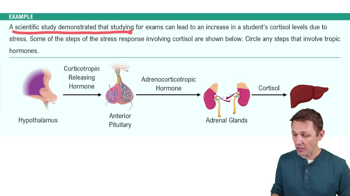
Describe the role of the hypothalamus: The hypothalamus is a key regulator of the stress response. It releases corticotropin-releasing hormone (CRH), which stimulates the pituitary gland to release adrenocorticotropic hormone (ACTH). ACTH then signals the adrenal cortex to produce cortisol, a critical hormone for managing stress.
Discuss the importance of these glands: The adrenal glands and hypothalamus work together to ensure the body can respond effectively to both acute and chronic stress. The hypothalamus initiates the stress response, while the adrenal glands execute the physiological changes needed to adapt to stressors.
Highlight the physiological significance: These glands are essential for maintaining homeostasis during stress by regulating heart rate, blood pressure, energy metabolism, and immune function, ensuring the body can cope with challenges effectively.

Verified video answer for a similar problem:
This video solution was recommended by our tutors as helpful for the problem above.
Video duration:
2mWas this helpful?
Key Concepts
Here are the essential concepts you must grasp in order to answer the question correctly.
Adrenal Glands
The adrenal glands, located on top of each kidney, play a crucial role in the stress response by producing hormones such as cortisol and adrenaline. Cortisol helps regulate metabolism and immune response, while adrenaline prepares the body for 'fight or flight' by increasing heart rate and energy availability. Their coordinated action is essential for managing stress and maintaining homeostasis.
Recommended video:
Guided course
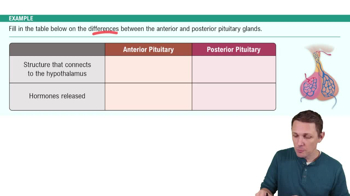
The Hypothalamus and Pituitary Gland Example 1
Hypothalamus-Pituitary-Adrenal (HPA) Axis
The HPA axis is a complex set of interactions between the hypothalamus, pituitary gland, and adrenal glands that regulates the body's response to stress. When faced with stress, the hypothalamus releases corticotropin-releasing hormone (CRH), stimulating the pituitary to secrete adrenocorticotropic hormone (ACTH), which in turn prompts the adrenal glands to produce cortisol. This feedback loop is vital for adapting to stressors.
Recommended video:
Guided course
The Hypothalamus and Pituitary Gland Example 3
Sympathetic Nervous System
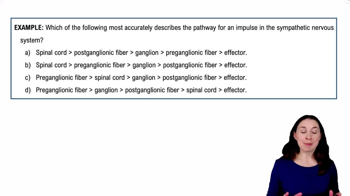
The sympathetic nervous system is part of the autonomic nervous system that activates the body's 'fight or flight' response during stressful situations. It triggers the release of adrenaline from the adrenal medulla, leading to physiological changes such as increased heart rate, heightened alertness, and energy mobilization. This rapid response is essential for immediate survival in threatening situations.
Recommended video:
Sympathetic Nervous System Example 3
Related Practice
Textbook Question
1
views
Textbook Question
Name three hormone antagonists of insulin and one of PTH.
1
views
Textbook Question
Describe the body location of each of the following endocrine organs: anterior pituitary, pineal gland, thymus, pancreas, ovaries, testes. Then, for each organ, name its hormones and their effect(s) on body processes. Finally, for each hormone, list the important results of its hypersecretion or hyposecretion.
1
views
Textbook Question
Two hormones are closely involved in the regulation of the fluid and electrolyte balance of the body. Name them, and explain their effects on their common target organ.
1
views
Textbook Question
The anterior pituitary is often referred to as the master endocrine gland, but it too has a 'master.' What controls the release of hormones by the anterior pituitary?
2
views
Textbook Question
Describe the chemical nature of hormones.
1
views