Compare the amount of movement possible in synarthrotic, amphiarthrotic, and diarthrotic joints. Relate these terms to the structural classification of joints—that is, to fibrous, cartilaginous, and synovial joints.
Ch. 5 The Skeletal System

Marieb13th EditionEssentials of Human Anatomy & PhysiologyISBN: 9780135624340Not the one you use?Change textbook
Chapter 5, Problem 21
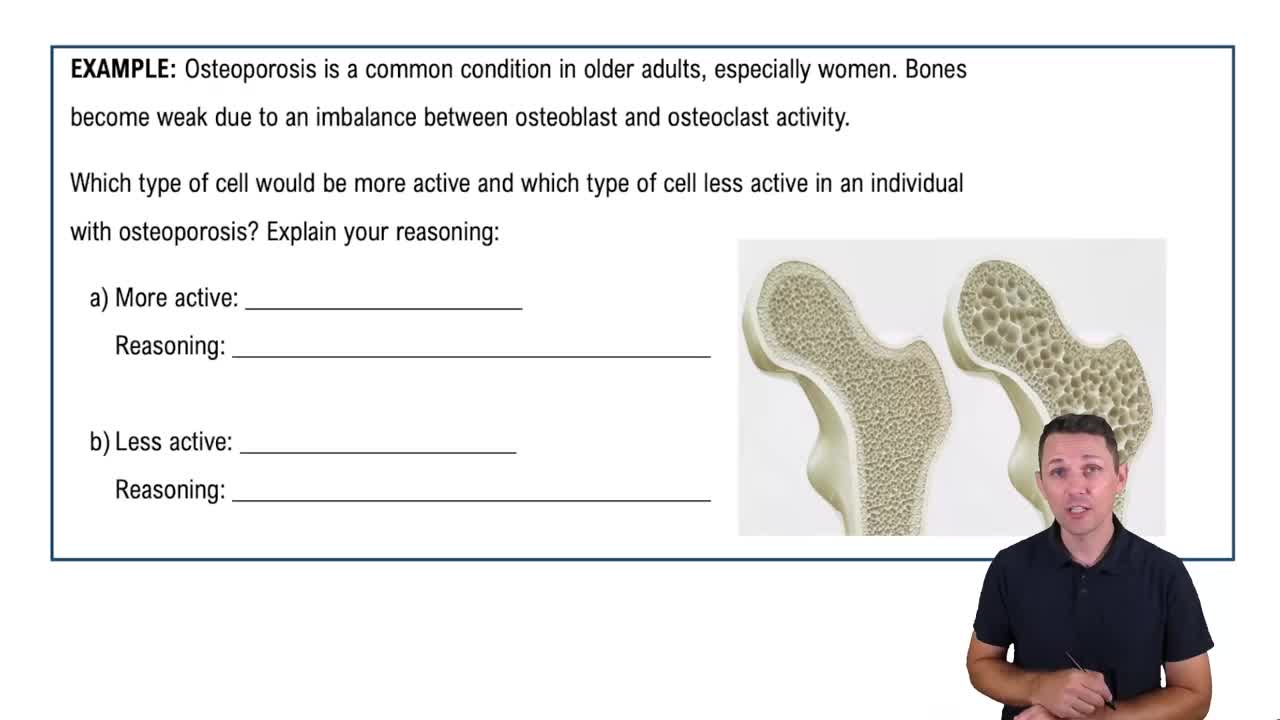
Deborah, a 75-year-old woman, stumbled slightly while walking, then felt a terrible pain in her left hip. At the hospital, X-ray images revealed that the hip was broken. Also, the compact bone and spongy bone throughout her spine were very thin. What was her probable condition?
Verified step by step guidance1
Step 1: Begin by identifying the symptoms described in the problem. Deborah experienced a hip fracture and has thin compact and spongy bone throughout her spine. These symptoms suggest a condition affecting bone density and strength.
Step 2: Recall the anatomy and physiology of bones. Compact bone provides strength and structure, while spongy bone is lighter and supports bone marrow. Both types of bone are affected by conditions that reduce bone density, such as osteoporosis.
Step 3: Understand the risk factors for osteoporosis. Age is a significant factor, especially in postmenopausal women due to decreased estrogen levels, which play a role in maintaining bone density. Deborah's age (75 years) and gender make her highly susceptible to this condition.
Step 4: Consider the physiological mechanism of osteoporosis. Osteoporosis occurs when the balance between bone resorption (breakdown) and bone formation is disrupted, leading to decreased bone mass and increased fragility. This explains the thin bones and susceptibility to fractures.
Step 5: Conclude that Deborah's probable condition is osteoporosis, based on her symptoms, age, gender, and the description of her bone structure. Further diagnostic tests, such as a bone density scan (DEXA), would confirm this diagnosis.

Verified video answer for a similar problem:
This video solution was recommended by our tutors as helpful for the problem above.
Video duration:
3mWas this helpful?
Key Concepts
Here are the essential concepts you must grasp in order to answer the question correctly.
Osteoporosis
Osteoporosis is a medical condition characterized by the weakening of bones, making them fragile and more susceptible to fractures. It often occurs due to a decrease in bone density, which can be influenced by factors such as age, hormonal changes, and nutritional deficiencies. In older adults, particularly postmenopausal women, osteoporosis is a common cause of hip fractures and spinal issues.
Recommended video:
Guided course
Microscopic Anatomy of Bones - Bone Cells Example 2
Bone Density
Bone density refers to the amount of bone mineral in bone tissue, which is crucial for maintaining bone strength and integrity. It is typically measured using dual-energy X-ray absorptiometry (DEXA) scans. Low bone density indicates a higher risk of fractures and is a key indicator of conditions like osteoporosis, especially in aging populations.
Recommended video:
Density of Liquid Water vs. Solid Ice
Fracture Types
Fractures are classified into different types based on their characteristics and causes. A common type in older adults is a low-energy fracture, which occurs from minimal trauma, such as a fall. Hip fractures are particularly concerning as they can lead to significant morbidity and complications, often requiring surgical intervention and rehabilitation.
Recommended video:
Types of Phosphorylation
Related Practice
Textbook Question
2
views
Textbook Question
What bones make up each hip bone (coxal bone)? Which of these is the largest?
Which has tuberosities that we sit on?
Which is the most anterior?
2
views
Textbook Question
Name all the bones with which the ulna articulates.
2
views
Textbook Question
Ryan, a 6-year-old child who is allergic to milk, has extremely bowed legs. What condition do you suspect, and what is the connection to not drinking milk?
1
views
Textbook Question
At work, a box fell from a shelf onto Ella's acromial region. In the emergency room, the physician felt that the head of her humerus had moved into the axilla. What had happened to Ella?
2
views