Ch. 3 Cells and Tissues
Marieb - Essentials of Human Anatomy & Physiology 13th Edition
Marieb13th EditionEssentials of Human Anatomy & PhysiologyISBN: 9780135624340Not the one you use?Change textbook
Chapter 3, Problem 8

Which epithelium is 'built' to withstand friction?
a. Simple squamous
b. Stratified squamous
c. Simple cuboidal
d. Simple columnar
e. Pseudostratified

Verified step by step guidance
1
Understand the question: The problem is asking which type of epithelium is designed to withstand friction. This requires knowledge of the structure and function of different epithelial tissues.
Recall the characteristics of each epithelial type: - Simple squamous: Thin, single layer of flat cells, designed for diffusion and filtration, not for withstanding friction. - Stratified squamous: Multiple layers of cells, with the outermost layer being flat, designed to protect against abrasion and friction. - Simple cuboidal: Single layer of cube-shaped cells, primarily involved in secretion and absorption, not friction resistance. - Simple columnar: Single layer of tall, column-like cells, specialized for absorption and secretion, not friction resistance. - Pseudostratified: Appears layered but is a single layer of cells with nuclei at different heights, often involved in secretion and movement of mucus, not friction resistance.
Identify the epithelium designed for friction resistance: Stratified squamous epithelium is specifically structured with multiple layers to protect underlying tissues from mechanical stress and friction. The outer layers can be shed and replaced, making it ideal for areas subject to abrasion.
Eliminate incorrect options: - Simple squamous, simple cuboidal, simple columnar, and pseudostratified epithelia are not designed to withstand friction due to their single-layer structure or specialized functions unrelated to mechanical protection.
Conclude the correct answer: The epithelium 'built' to withstand friction is stratified squamous. This tissue is commonly found in areas like the skin, mouth, and esophagus, where friction is frequent.

Verified video answer for a similar problem:

This video solution was recommended by our tutors as helpful for the problem above.
Video duration:
3m
Was this helpful?

Key Concepts

Here are the essential concepts you must grasp in order to answer the question correctly.

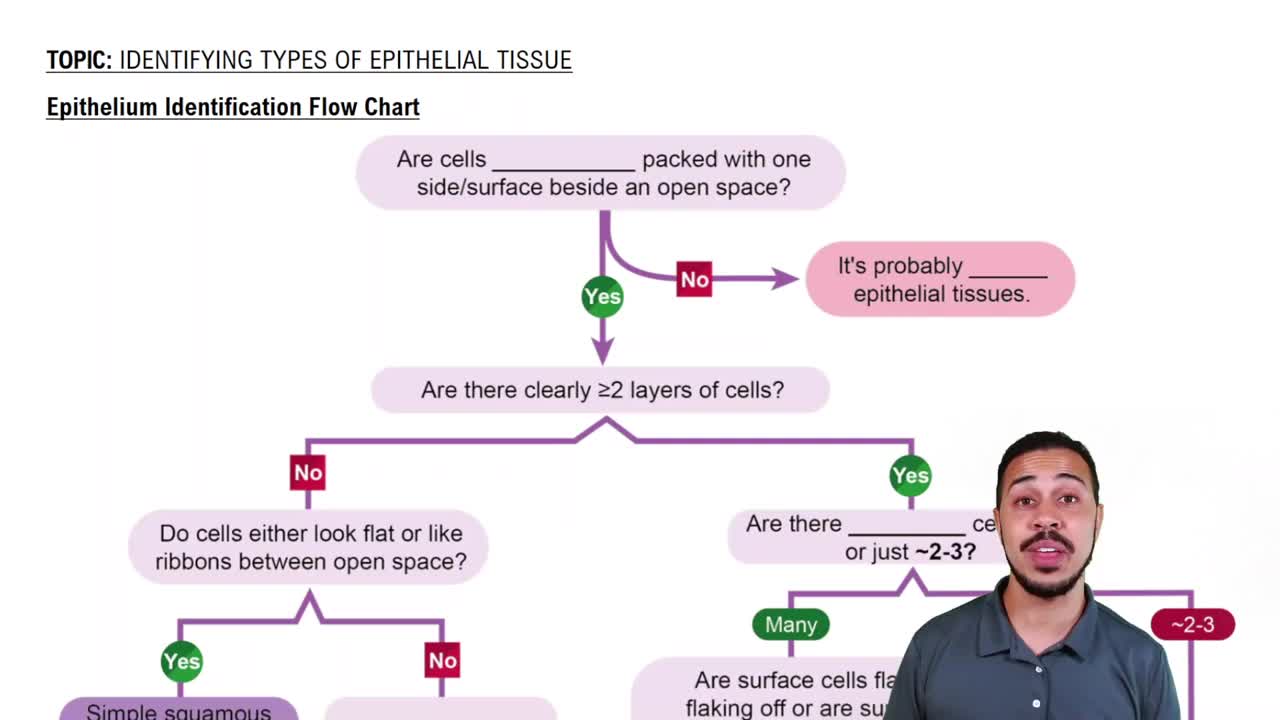
Types of Epithelium

Epithelium is classified into various types based on the number of cell layers and the shape of the cells. The main categories include simple (single layer) and stratified (multiple layers) epithelium, with shapes such as squamous (flat), cuboidal (cube-shaped), and columnar (tall and column-like). Understanding these classifications is essential for determining the functional properties of different epithelial tissues.
Recommended video:
Guided course
16:19
Epithelium Identification Flow Chart

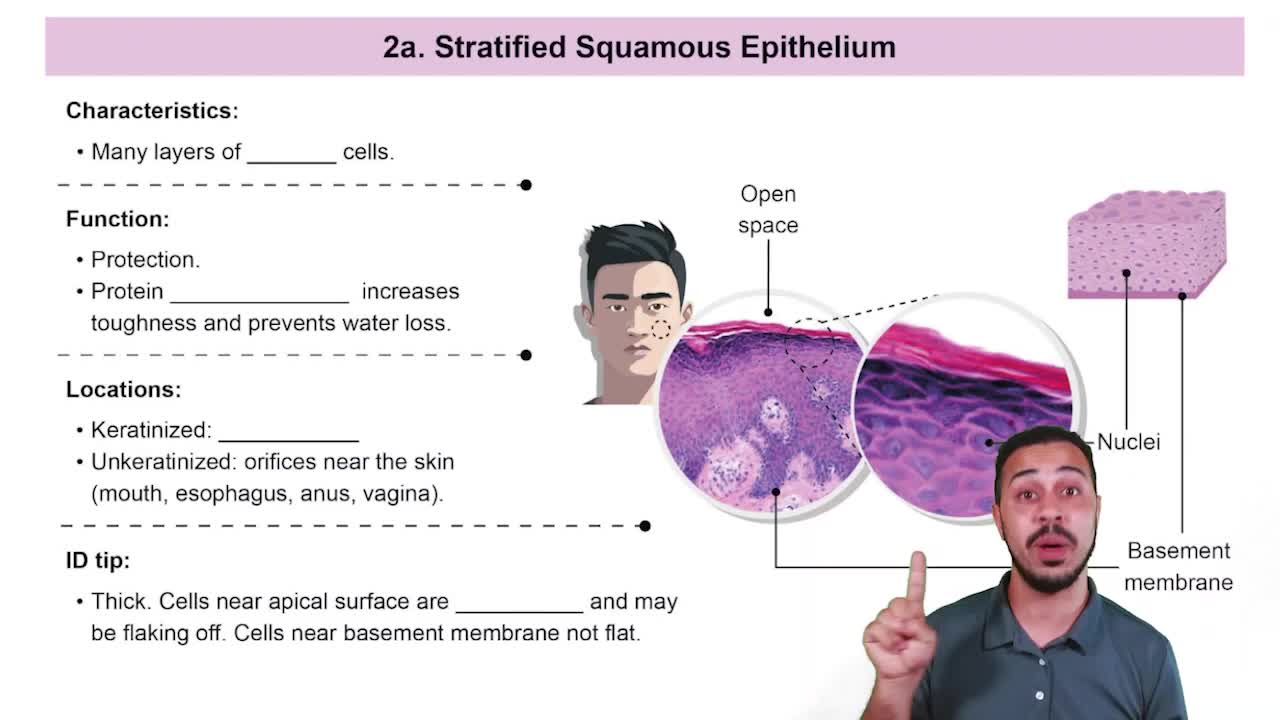
Function of Stratified Squamous Epithelium

Stratified squamous epithelium consists of multiple layers of cells, providing a robust barrier against mechanical stress and friction. This type of epithelium is commonly found in areas subject to abrasion, such as the skin, mouth, and esophagus, where it protects underlying tissues from damage and dehydration.
Recommended video:
Guided course
11:27
Stratified Squamous Epithelia

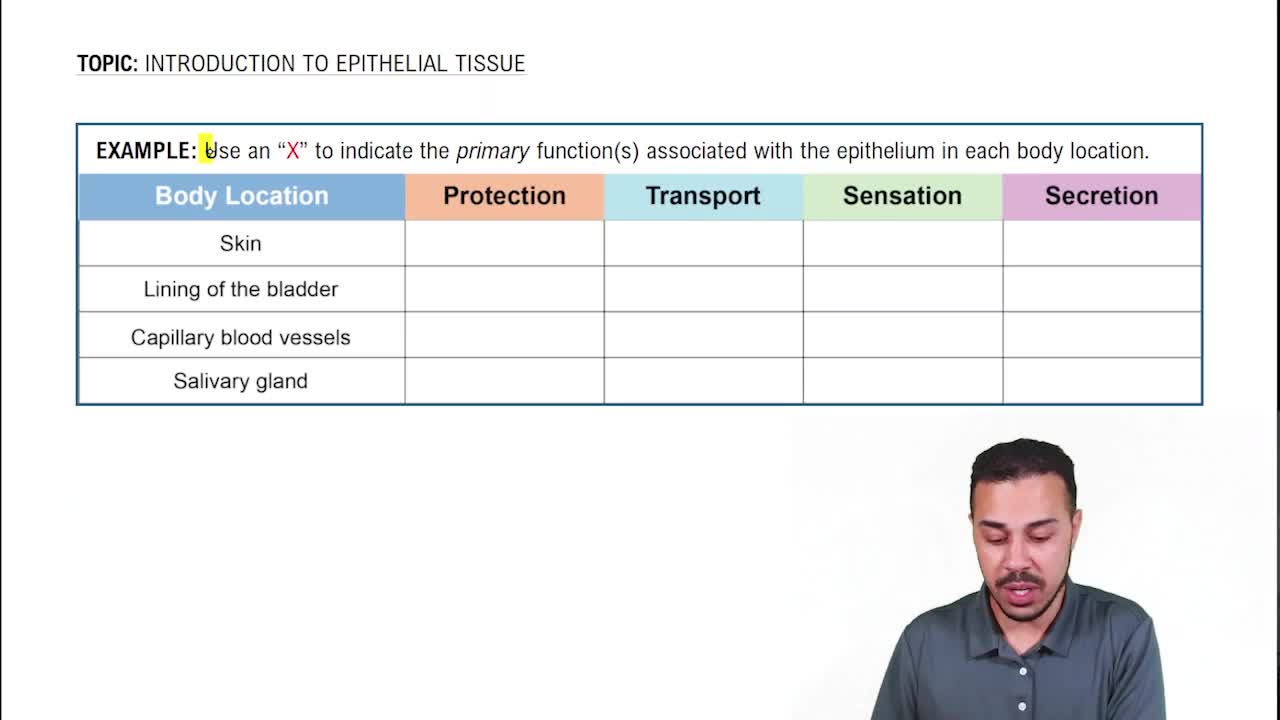
Role of Epithelial Tissue in Protection

Epithelial tissues serve various functions, including protection, absorption, secretion, and sensation. The protective role is particularly important in areas exposed to friction and wear, where specialized epithelial types, like stratified squamous epithelium, are adapted to withstand such physical stress, ensuring the integrity of underlying tissues.
Recommended video:
Guided course
05:24
Introduction to Epithelial Tissue Example 1
Related Practice
Textbook Question

Match the appropriate structure with the proper description and/or function.

1. Made of dense, irregular connective tissue

 2. Produce sebum

3. Helps regulate body temperature by producing sweat

4. Cause fingerprints

5. Houses the hair root

6. Superficial keratinized stratified squamous epithelium

7. Deep pressure receptors

8. Vascular layer that houses skin appendages

a. Dermal papillae

b. Lamellar corpuscles

c. Dermis

d. Hair follicle

e. Epidermis

f. Eccrine sweat gland

g. Reticular layer

h. Sebaceous glands

2
views
Textbook Question

What kind of connective tissue acts as a sponge, soaking up fluid when edema occurs?

a. Areolar connective

b. Adipose connective

c. Dense irregular connective

d. Reticular connective

e. Vascular

2
views
Textbook Question

A cell stimulated to increase its steroid production will have abundant:

a. Ribosomes

b. Rough ER

c. Smooth ER

d. Golgi apparatus

e. Secretory vesicles

3
views
Textbook Question

For diffusion to occur, there must be:

a. A selectively permeable membrane

b. Equal amounts of solute

c. A concentration difference

d. Some sort of carrier system

e. All of the above

1
views
Textbook Question

In which of the following tissue types might you expect to find goblet cells?

a. Simple cuboidal

b. Simple columnar

c. Simple squamous

d. Stratified squamous

e. Transitional

1
views
Textbook Question

What kind of connective tissue prevents muscles from pulling away from bones during contraction?

a. Dense connective

b. Areolar

c. Elastic connective

d. Hyaline cartilage

1
views