Ch. 13 The Respiratory System
Marieb - Essentials of Human Anatomy & Physiology 13th Edition
Marieb13th EditionEssentials of Human Anatomy & PhysiologyISBN: 9780135624340Not the one you use?Change textbook
Chapter 13, Problem 12

What is it about the structure of the alveoli that makes them an ideal site for gas exchange?

Verified step by step guidance
1
Understand the function of alveoli: Alveoli are tiny air sacs in the lungs where gas exchange occurs between the air and the blood. Their structure is specialized to maximize efficiency in this process.
Examine the large surface area: The alveoli are numerous (about 300 million in the human lungs), and their spherical shape provides a large surface area for gas exchange. This large surface area allows for more oxygen and carbon dioxide to be exchanged simultaneously.
Consider the thin walls of alveoli: The walls of the alveoli are made of a single layer of epithelial cells, which minimizes the distance for diffusion of gases like oxygen and carbon dioxide. This thin barrier facilitates rapid gas exchange.
Analyze the surrounding capillaries: Alveoli are surrounded by a dense network of capillaries. These capillaries are also thin-walled, allowing for efficient diffusion of gases between the alveoli and the blood.
Note the moist environment: The alveoli are coated with a thin layer of fluid that helps dissolve gases, making it easier for oxygen to diffuse into the blood and carbon dioxide to diffuse out of the blood.

Verified video answer for a similar problem:

This video solution was recommended by our tutors as helpful for the problem above.
Video duration:
2m
Was this helpful?

Key Concepts

Here are the essential concepts you must grasp in order to answer the question correctly.

Alveolar Structure

The alveoli are tiny, balloon-like structures in the lungs that have a large surface area due to their numerous folds and clusters. This extensive surface area allows for more efficient gas exchange, as it maximizes the contact between air and blood. Additionally, the thin walls of the alveoli, composed of a single layer of epithelial cells, facilitate rapid diffusion of oxygen and carbon dioxide.
Recommended video:
Guided course
4:16
Structure of the Eyeball Example 1

Surfactant

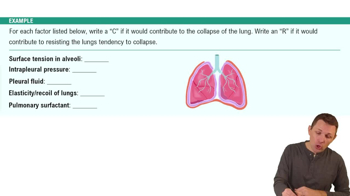
Surfactant is a substance produced by the cells lining the alveoli that reduces surface tension. This is crucial because it prevents the alveoli from collapsing and ensures they remain open for gas exchange. By lowering surface tension, surfactant also allows for easier expansion of the alveoli during inhalation, enhancing the efficiency of breathing.
Recommended video:
Guided course
3:49
Pressure in the Lungs and Pleural Cavity Example 1

Capillary Network

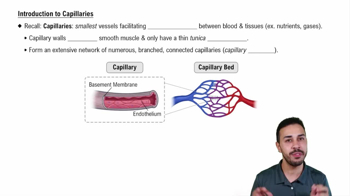
The alveoli are surrounded by a dense network of capillaries, which are tiny blood vessels that facilitate the exchange of gases. This close proximity between alveoli and capillaries ensures that oxygen can quickly diffuse into the blood while carbon dioxide diffuses out. The large surface area and thin walls of both the alveoli and capillaries optimize the efficiency of gas exchange, making it a rapid process.
Recommended video:
4:36
Introduction to Capillaries