What is it about the structure of the alveoli that makes them an ideal site for gas exchange?
Ch. 13 The Respiratory System

Marieb13th EditionEssentials of Human Anatomy & PhysiologyISBN: 9780135624340Not the one you use?Change textbook
Chapter 13, Problem 8
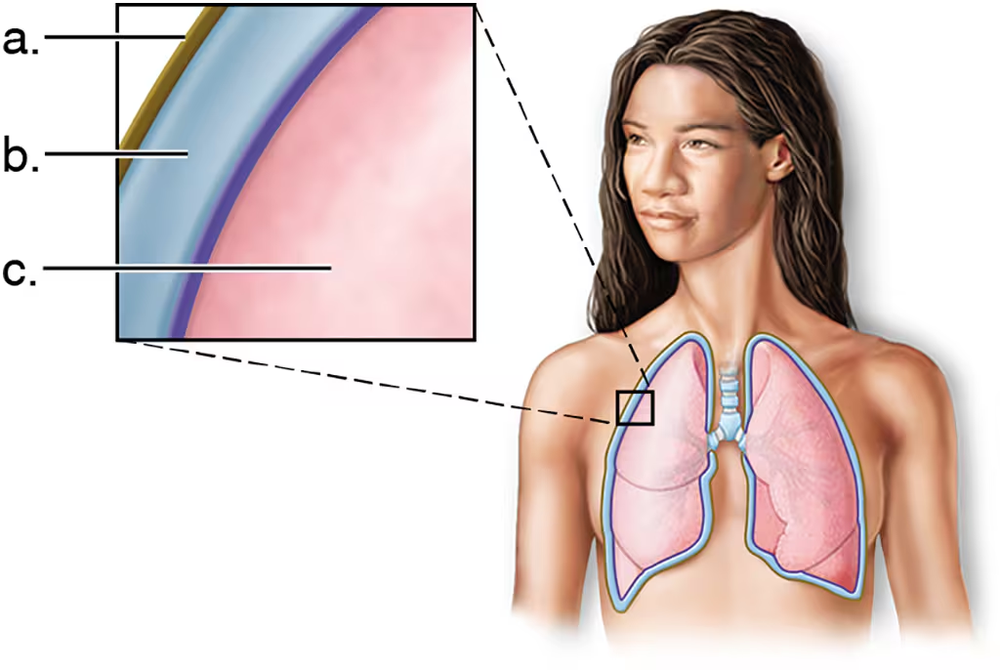
Which of the following represents intrapleural pressure?

Verified step by step guidance1
Understand the concept of intrapleural pressure: Intrapleural pressure is the pressure within the pleural cavity, the space between the visceral and parietal pleurae surrounding the lungs. It is typically negative relative to atmospheric pressure, which helps keep the lungs inflated.
Review the physiological mechanism: The negative intrapleural pressure is created by the opposing forces of the lungs' elastic recoil (which pulls inward) and the chest wall's tendency to expand outward. This balance maintains the negative pressure.
Analyze the options provided: Carefully examine the choices (a, b, c) to determine which ones describe or represent intrapleural pressure. Look for descriptions or values that align with the concept of a pressure that is negative relative to atmospheric pressure.
Eliminate incorrect options: Discard any choices that describe pressures unrelated to the pleural cavity, such as atmospheric pressure, alveolar pressure, or pressures that are positive rather than negative.
Select the correct answers: Identify all options that accurately represent intrapleural pressure based on your understanding of its definition and physiological role.

Verified video answer for a similar problem:
This video solution was recommended by our tutors as helpful for the problem above.
Video duration:
2mWas this helpful?
Key Concepts
Here are the essential concepts you must grasp in order to answer the question correctly.
Intrapleural Pressure
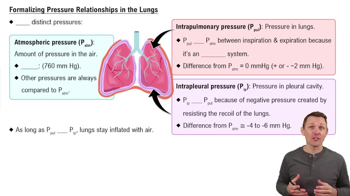
Intrapleural pressure is the pressure within the pleural cavity, the thin fluid-filled space between the two pleurae of the lungs. It is typically negative relative to atmospheric pressure, which helps keep the lungs inflated and facilitates breathing. This pressure is crucial for maintaining lung expansion and preventing lung collapse.
Recommended video:
Guided course
Formalizing Pressure Relationships in the Lungs
Pleural Cavity
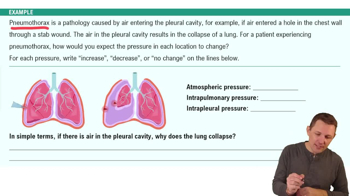
The pleural cavity is the space between the visceral pleura (which covers the lungs) and the parietal pleura (which lines the chest wall). This cavity contains pleural fluid, which reduces friction during breathing and helps maintain the negative pressure necessary for lung inflation. Understanding the anatomy and function of the pleural cavity is essential for grasping intrapleural pressure.
Recommended video:
Guided course
Pressure in the Lungs and Pleural Cavity Example 2
Respiratory Mechanics
Respiratory mechanics refers to the physical principles governing the movement of air into and out of the lungs. It includes concepts such as pressure gradients, lung compliance, and airway resistance. A solid understanding of respiratory mechanics is vital for interpreting how intrapleural pressure influences ventilation and overall respiratory function.
Recommended video:
Internal Regulation - The Myogenic Mechanism
Related Practice
Textbook Question
2
views
Textbook Question
Clearly explain the difference between external and internal respiration.
1
views
Textbook Question
More than one choice may apply.
Which of the following changes will accompany the loss of lung elasticity associated with aging?
a. Increase in tidal volume
b. Increase in inspiratory reserve volume
c. Increase in residual volume
d. Increase in vital capacity
Textbook Question
The contraction of the diaphragm and the external intercostal muscles begins inspiration. What happens, in terms of volume and pressure changes in the lungs, when these muscles contract?
Textbook Question
More than one choice may apply.
During inspiration, intrapulmonary pressure is
a. Greater than atmospheric pressure
b. Less than atmospheric pressure
c. Greater than intrapleural pressure
d. Less than intrapleural pressure
1
views