Ch. 11 Cardiovascular System
Marieb - Essentials of Human Anatomy & Physiology 13th Edition
Marieb13th EditionEssentials of Human Anatomy & PhysiologyISBN: 9780135624340Not the one you use?Change textbook
Chapter 11, Problem 6

More than one choice may apply.
Soon after the onset of ventricular systole, the
a. AV valves close.
b. semilunar valves open.
c. first heart sound is heard.
d. aortic pressure increases.

Verified step by step guidance
1
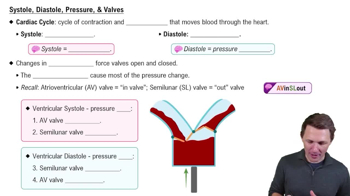
Understand the phases of the cardiac cycle: Ventricular systole refers to the contraction of the ventricles, which occurs after the ventricles fill with blood during diastole. This contraction generates pressure within the ventricles.
Analyze the behavior of the AV (atrioventricular) valves: During ventricular systole, the pressure in the ventricles exceeds the pressure in the atria, causing the AV valves (tricuspid and mitral valves) to close. This prevents backflow of blood into the atria.
Examine the semilunar valves: As ventricular pressure continues to rise during systole, it eventually exceeds the pressure in the arteries (aorta and pulmonary artery), causing the semilunar valves (aortic and pulmonary valves) to open, allowing blood to be ejected into the arteries.
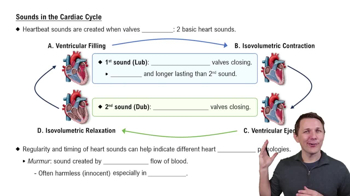
Relate the first heart sound to valve closure: The first heart sound (S1) is produced by the closure of the AV valves at the beginning of ventricular systole. This sound is often described as a 'lub' sound.
Consider the effect on aortic pressure: As blood is ejected from the left ventricle into the aorta during systole, the pressure in the aorta increases. This is a direct result of the ventricular contraction and the opening of the aortic semilunar valve.

Verified video answer for a similar problem:

This video solution was recommended by our tutors as helpful for the problem above.
Was this helpful?

Key Concepts

Here are the essential concepts you must grasp in order to answer the question correctly.

Ventricular Systole

Ventricular systole is the phase of the cardiac cycle when the ventricles contract, pumping blood into the aorta and pulmonary artery. This phase is crucial for maintaining blood circulation throughout the body. It begins after the atria have emptied their blood into the ventricles and is marked by a rapid increase in ventricular pressure.
Recommended video:
Guided course
7:13
Systole, Diastole, Pressure, & Valves

Heart Valves

The heart contains four main valves: the atrioventricular (AV) valves and the semilunar valves. During ventricular systole, the AV valves close to prevent backflow into the atria, while the semilunar valves open to allow blood to flow into the arteries. Understanding the function of these valves is essential for grasping the mechanics of blood flow during the cardiac cycle.
Recommended video:
Guided course
7:13
Systole, Diastole, Pressure, & Valves

Cardiac Sounds

The first heart sound, often described as 'lub,' occurs when the AV valves close at the beginning of ventricular systole. This sound is an important indicator of heart function and is used in clinical settings to assess cardiac health. The timing of this sound relative to the phases of the cardiac cycle is critical for understanding heart dynamics.
Recommended video:
Guided course
7:54
Sounds in the Cardiac Cycle