Ch. 1 The Human Body: An Orientation
Marieb - Essentials of Human Anatomy & Physiology 13th Edition
Marieb13th EditionEssentials of Human Anatomy & PhysiologyISBN: 9780135624340Not the one you use?Change textbook
Chapter 1, Problem 7

More than one choice may apply.
The base of the heart is its _______surface.
a. Diaphragmatic
b. Superior
c. Anterior
d. Inferior

Verified step by step guidance
1
Understand the anatomical orientation of the heart: The heart has several surfaces, including the diaphragmatic (inferior), anterior, posterior, and superior surfaces. The base of the heart refers to the part opposite the apex and is primarily formed by the atria, especially the left atrium.
Analyze the term 'base of the heart': The base is located at the superior aspect of the heart and is where the great vessels (aorta, pulmonary arteries, and veins) emerge. It is not the diaphragmatic or inferior surface.
Evaluate the options: The diaphragmatic surface refers to the part of the heart that rests on the diaphragm, which is the inferior surface. The anterior surface is the front-facing part of the heart. The superior surface is where the base is located.
Eliminate incorrect choices: Since the base of the heart is superior and not diaphragmatic, anterior, or inferior, you can rule out options a, c, and d.
Select the correct answer(s): Based on the anatomical description, the base of the heart corresponds to the superior surface. Therefore, the correct choice is 'b. superior.'

Verified video answer for a similar problem:

This video solution was recommended by our tutors as helpful for the problem above.
Was this helpful?

Key Concepts

Here are the essential concepts you must grasp in order to answer the question correctly.

Anatomy of the Heart

The heart is a muscular organ with distinct surfaces and orientations. Its base refers to the upper part where the major blood vessels enter and exit, primarily facing upward and backward. Understanding the anatomical positioning of the heart is crucial for identifying its various surfaces.
Recommended video:
Guided course
6:13
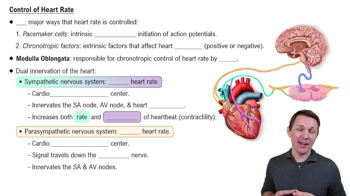
Control of Heart Rate

Heart Surfaces

The heart has several surfaces, including the anterior (front), posterior (back), inferior (bottom), and base (top). The base is specifically associated with the atria and is oriented towards the right shoulder, contrasting with the diaphragmatic surface, which faces downward towards the diaphragm.
Recommended video:
4:05
Cell Surface Receptors

Orientation in Cardiac Anatomy

In cardiac anatomy, orientation is vital for understanding the heart's position within the thoracic cavity. The terms 'superior' and 'inferior' describe vertical positioning, while 'anterior' and 'posterior' describe horizontal positioning. Recognizing these orientations helps in accurately identifying the heart's surfaces and their respective functions.
Recommended video:
Guided course
9:44
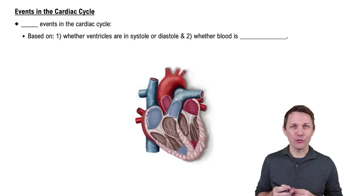
Events in the Cardiac Cycle