Describe some cause(s) of muscle fatigue and define this term clearly.
Ch. 9 Muscles and Muscle Tissue

Marieb, Hoehn11th EditionHuman Anatomy & PhysiologyISBN: 9780136874034Not the one you use?Change textbook
Chapter 9, Problem 22
When a suicide victim was found, the coroner was unable to remove the drug vial clutched in his hand. Explain the reasons for this. If the victim had been discovered three days later, would the coroner have had the same difficulty? Explain.
Verified step by step guidance1
Understand that rigor mortis is the postmortem stiffening of muscles caused by chemical changes in muscle tissue after death, primarily due to the depletion of ATP, which prevents muscle relaxation.
Recognize that rigor mortis typically begins within 2 to 6 hours after death, peaks around 12 hours, and can last up to 48 to 72 hours before muscle tissues begin to relax again as decomposition progresses.
Apply this knowledge to the scenario: the coroner could not remove the drug vial because the victim's hand muscles were stiff and fixed in place due to rigor mortis, making it difficult to open the hand.
Consider the time factor: if the victim had been discovered three days later, rigor mortis would likely have passed, and muscle stiffness would have diminished due to tissue breakdown, making it easier for the coroner to remove the vial.
Summarize that the presence and timing of rigor mortis explain the difficulty in removing the vial immediately after death, and the absence of rigor mortis after several days would reduce this difficulty.

Verified video answer for a similar problem:
This video solution was recommended by our tutors as helpful for the problem above.
Video duration:
2mWas this helpful?
Key Concepts
Here are the essential concepts you must grasp in order to answer the question correctly.
Rigor Mortis
Rigor mortis is the postmortem stiffening of muscles caused by chemical changes in muscle tissue after death. It typically begins within 2-6 hours and can cause a deceased person's muscles to contract, making it difficult to release objects held tightly, such as a drug vial.
Postmortem Changes Over Time
After death, the body undergoes various changes including rigor mortis, livor mortis, and decomposition. Rigor mortis usually dissipates after 24-48 hours as muscle tissues break down, so after three days, the stiffness would have lessened, making it easier to remove objects from the deceased's grasp.
Recommended video:
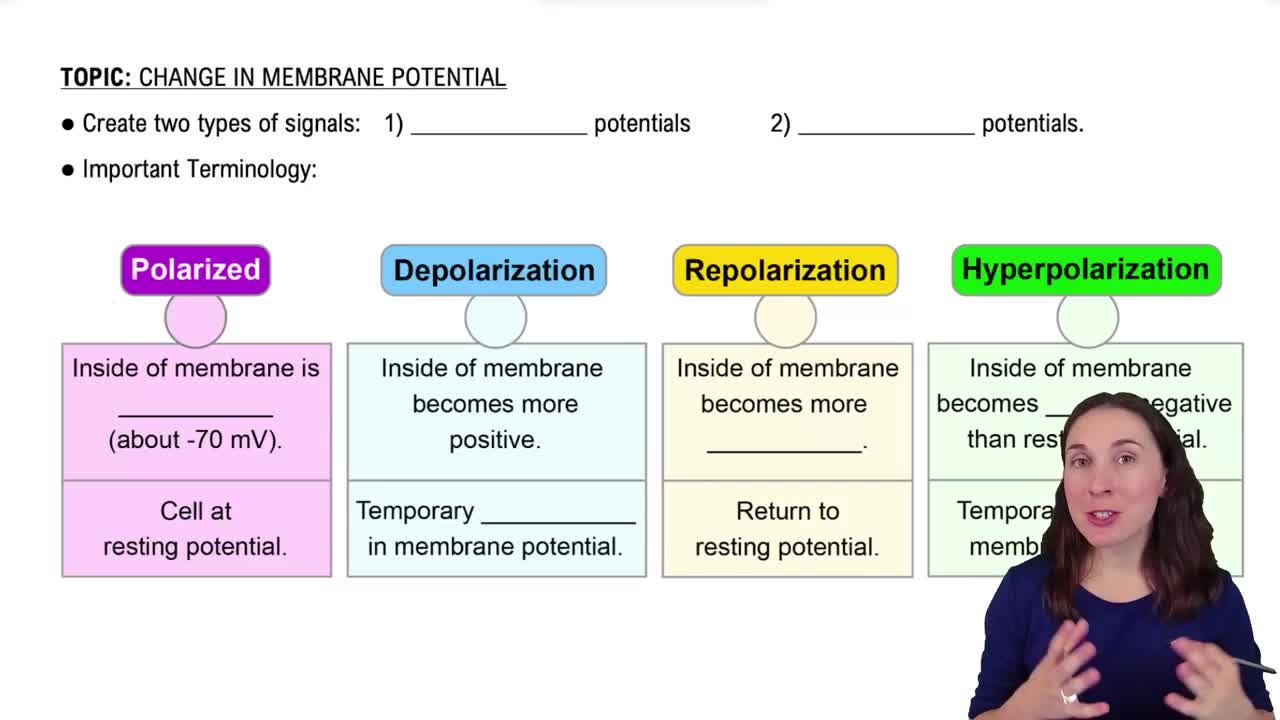
Change in Membrane Potential
Muscle Contraction Mechanism in Death
Muscle contraction after death occurs due to the lack of ATP, which normally allows muscles to relax. Without ATP, muscles remain contracted, causing a firm grip. This biochemical process explains why the coroner could not remove the vial immediately after death.
Recommended video:
Guided course
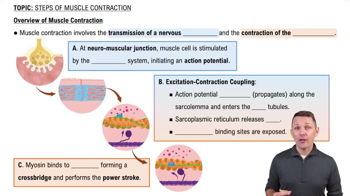
Overview of Muscle Contraction
Related Practice
Textbook Question
Textbook Question
Explain how a slight (but smooth) contraction differs from a vigorous contraction of the same muscle. Use the concepts of multiple motor unit summation.
2
views
Textbook Question
a. Describe the structure of a sarcomere and indicate the relationship of the sarcomere to myofilaments.
b. Explain the sliding filament model of contraction using appropriately labeled diagrams of a relaxed and a contracted sarcomere.
1
views
Textbook Question
True or false: Most muscles contain a predominance of one skeletal muscle fiber type. Explain the reasoning behind your choice.
5
views
Textbook Question
Smooth muscle has some unique properties, such as low energy usage, and the ability to maintain contraction over long periods. Tie these properties to the function of smooth muscle in the body.
1
views
Textbook Question
Define and draw a motor unit.
2
views