Mrs. Gaucher received second-degree burns on her abdomen when she dropped a kettle of boiling water. She asked her doctor (worriedly) if she would need a skin graft. What do you think he told her?
Ch. 5 The Integumentary System

Marieb, Hoehn11th EditionHuman Anatomy & PhysiologyISBN: 9780136874034Not the one you use?Change textbook
Chapter 5, Problem 23
Why are there no skin cancers that originate from stratum corneum cells?
Verified step by step guidance1
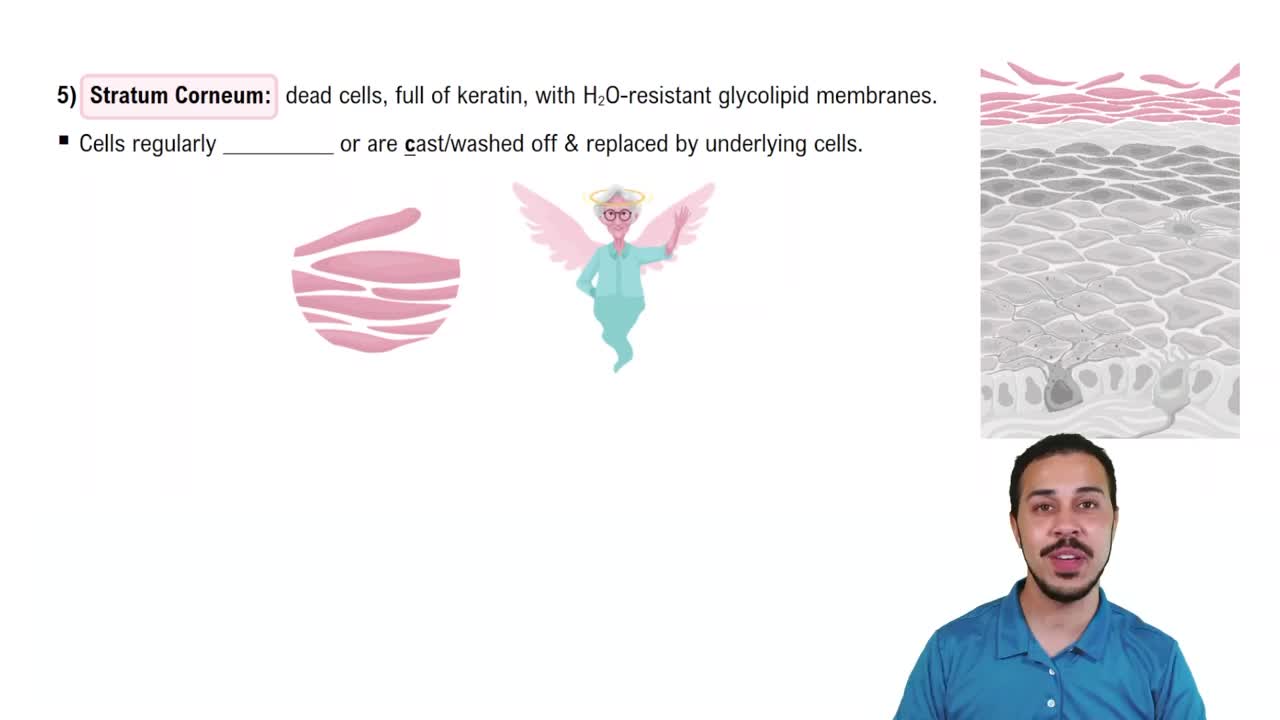
Understand the structure and function of the stratum corneum: it is the outermost layer of the epidermis, composed mainly of dead, flattened keratinized cells that have lost their nuclei and organelles.
Recognize that cancer originates from cells that are capable of division and replication; since the stratum corneum cells are dead and non-dividing, they cannot undergo the mutations necessary to become cancerous.
Recall that skin cancers typically arise from living cells in the deeper layers of the epidermis, such as the basal layer (stratum basale) or the squamous layer (stratum spinosum), where cells are actively dividing.
Note that the stratum corneum serves as a protective barrier and is constantly shed and replaced by cells from lower layers, so it does not provide a stable environment for cancerous growth.
Conclude that the absence of living, mitotically active cells in the stratum corneum explains why no skin cancers originate from this layer.

Verified video answer for a similar problem:
This video solution was recommended by our tutors as helpful for the problem above.
Video duration:
2mWas this helpful?
Key Concepts
Here are the essential concepts you must grasp in order to answer the question correctly.
Structure and Function of the Stratum Corneum
The stratum corneum is the outermost layer of the epidermis, composed mainly of dead, flattened keratinized cells. These cells lack nuclei and organelles, making them metabolically inactive and unable to divide or mutate, which is essential for cancer development.
Recommended video:
Epidermal Layers: Stratum Corneum
Cellular Origin of Skin Cancer
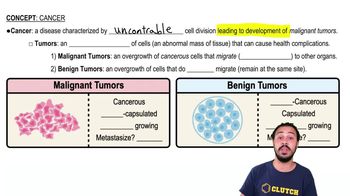
Skin cancers typically arise from living cells capable of division and mutation, such as basal cells in the stratum basale or squamous cells in the stratum spinosum. Since the stratum corneum cells are dead and non-dividing, they cannot serve as a source for cancerous growth.
Recommended video:
Cancer
Role of Cell Proliferation in Cancer Formation
Cancer develops when cells undergo uncontrolled proliferation due to genetic mutations. Only cells with active DNA replication and repair mechanisms, found in the lower epidermal layers, can accumulate mutations leading to cancer, unlike the inert cells of the stratum corneum.
Recommended video:
Cancer
Related Practice
Textbook Question
2
views
Textbook Question
Explain each of these familiar phenomena in terms of what you learned in this chapter:
a. Pimples
b. Dandruff
c. Greasy hair and 'shiny nose
d. Stretch marks from gaining weight
e. Freckles
1
views
Textbook Question
Which epidermal cells contain keratohyaline and lamellar granules?
1
views
Textbook Question
Count Dracula, the most famous vampire, rumored to have killed at least 200,000 people, was based on a real person who lived in eastern Europe about 600 years ago. He was indeed a “monster,” although he was not a real vampire. The historical Count Dracula may have suffered from which of the following?
(a) Porphyria
(b) EB
(c) Halitosis
(d) Vitiligo
Explain your answer.
1
views