Mrs. Gaucher received second-degree burns on her abdomen when she dropped a kettle of boiling water. She asked her doctor (worriedly) if she would need a skin graft. What do you think he told her?
Ch. 5 The Integumentary System

Marieb, Hoehn11th EditionHuman Anatomy & PhysiologyISBN: 9780136874034Not the one you use?Change textbook
Chapter 5, Problem 22
Explain each of these familiar phenomena in terms of what you learned in this chapter:
a. Pimples
b. Dandruff
c. Greasy hair and 'shiny nose
d. Stretch marks from gaining weight
e. Freckles
Verified step by step guidance1
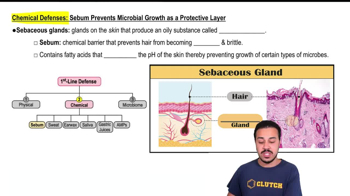
For pimples, explain how they result from the inflammation of sebaceous (oil) glands in the skin. When these glands produce excess sebum, it can clog hair follicles, trapping bacteria and dead skin cells, which leads to swelling and redness characteristic of pimples.
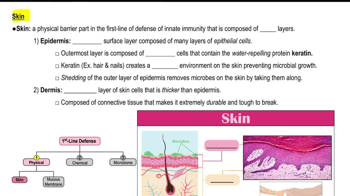
For dandruff, describe it as the shedding of dead skin cells from the scalp. This occurs when the normal process of skin cell turnover accelerates, often due to irritation or fungal activity, causing visible flakes and sometimes itching.
For greasy hair and a 'shiny nose,' discuss how overactive sebaceous glands produce excess sebum, which coats the hair and skin surface. This oily layer reflects light, giving hair a greasy appearance and skin a shiny look, especially in areas with many sebaceous glands like the nose.
For stretch marks from gaining weight, explain that rapid stretching of the skin causes the dermis (the middle layer of skin) to tear or become damaged. This disrupts collagen and elastin fibers, leading to visible streaks or lines known as stretch marks.
For freckles, describe them as small, concentrated spots of melanin pigment produced by melanocytes in response to UV exposure. Freckles are more visible in individuals with lighter skin and represent localized increases in pigmentation rather than an increase in the number of melanocytes.

Verified video answer for a similar problem:
This video solution was recommended by our tutors as helpful for the problem above.
Video duration:
2mWas this helpful?
Key Concepts
Here are the essential concepts you must grasp in order to answer the question correctly.
Sebaceous Glands and Sebum Production
Sebaceous glands are skin glands that produce sebum, an oily substance that lubricates hair and skin. Overproduction or blockage of sebum can lead to pimples and greasy hair, as excess oil clogs pores and creates a shiny appearance.
Recommended video:
Sebum
Skin Cell Turnover and Flaking
The skin continuously renews itself by shedding dead cells and generating new ones. Dandruff results from an accelerated shedding of skin cells on the scalp, often linked to dryness or fungal activity, causing visible flakes.
Recommended video:
Skin
Skin Elasticity and Melanin Production
Skin elasticity refers to the skin's ability to stretch and return to shape; overstretching can cause stretch marks due to collagen fiber damage. Melanin is the pigment responsible for skin color, and its uneven distribution leads to freckles, which are small, concentrated spots of pigment.
Recommended video:
Skin
Related Practice
Textbook Question
2
views
Textbook Question
The rule of nines is helpful clinically in
a. Diagnosing skin cancer
b. Estimating the extent of a burn
c. Estimating how serious a cancer is
d. Preventing acne
3
views
Textbook Question
Why are there no skin cancers that originate from stratum corneum cells?
2
views
Textbook Question
Which epidermal cells contain keratohyaline and lamellar granules?
1
views
Textbook Question
Count Dracula, the most famous vampire, rumored to have killed at least 200,000 people, was based on a real person who lived in eastern Europe about 600 years ago. He was indeed a “monster,” although he was not a real vampire. The historical Count Dracula may have suffered from which of the following?
(a) Porphyria
(b) EB
(c) Halitosis
(d) Vitiligo
Explain your answer.
1
views