Ch. 3 Cells: The Living Units
Marieb - Human Anatomy & Physiology 11th Edition
Marieb, Hoehn11th EditionHuman Anatomy & PhysiologyISBN: 9780136874034Not the one you use?Change textbook
Chapter 3, Problem 17

Comment on the role of the sodium-potassium pump in maintaining a cell's resting membrane potential.

Verified step by step guidance
1
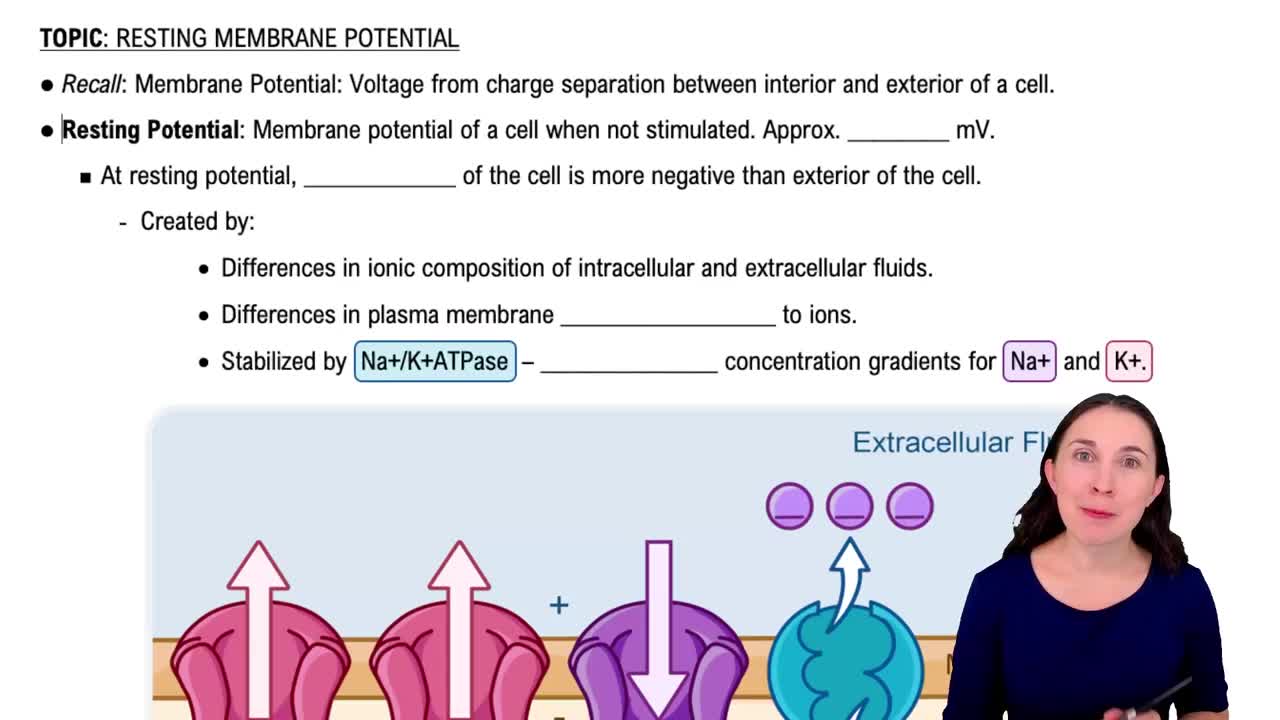
Understand that the resting membrane potential is the electrical potential difference across the cell membrane when the cell is at rest, typically around -70 mV in many cells.
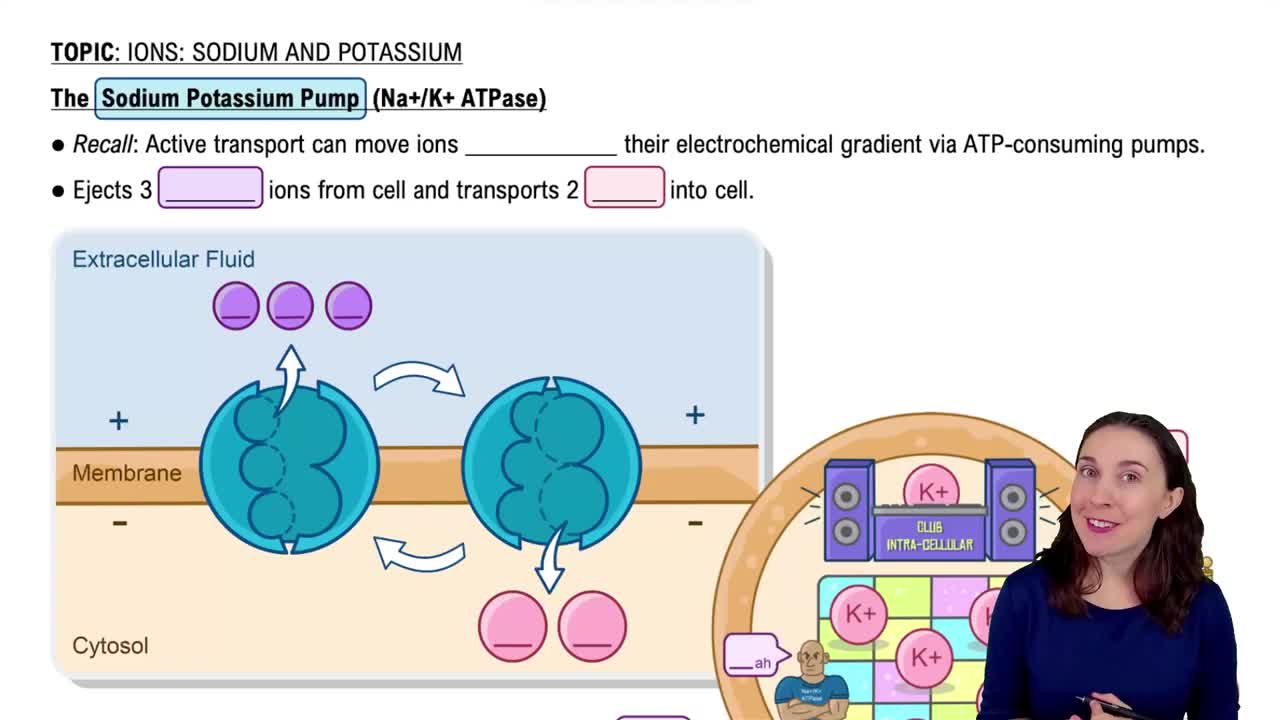
Recognize that the sodium-potassium pump (Na\(\textsuperscript{+}\)/K\(\textsuperscript{+}\) ATPase) actively transports ions against their concentration gradients using energy from ATP hydrolysis.
Note that the pump moves 3 sodium ions (Na\(\textsuperscript{+}\)) out of the cell and 2 potassium ions (K\(\textsuperscript{+}\)) into the cell, which helps maintain the concentration gradients of these ions across the membrane.
Explain that these ion gradients are crucial because they create a difference in charge distribution, contributing to the negative charge inside the cell relative to the outside, which is essential for the resting membrane potential.
Finally, emphasize that the pump's activity is electrogenic (it moves unequal charges), which directly contributes to the negativity inside the cell, thus helping to maintain and stabilize the resting membrane potential.

Verified video answer for a similar problem:

This video solution was recommended by our tutors as helpful for the problem above.
Video duration:
4m
Was this helpful?

Key Concepts

Here are the essential concepts you must grasp in order to answer the question correctly.

Resting Membrane Potential

The resting membrane potential is the electrical voltage difference across a cell's membrane when the cell is at rest. It typically ranges from -60 to -70 millivolts in neurons, resulting from the uneven distribution of ions, mainly sodium and potassium, inside and outside the cell.
Recommended video:
07:53
Resting Membrane Potential

Sodium-Potassium Pump Function

The sodium-potassium pump is an active transport protein that moves 3 sodium ions out of the cell and 2 potassium ions into the cell against their concentration gradients. This process requires ATP and helps maintain the ion concentration differences essential for cellular functions.
Recommended video:
03:40
The Sodium Potassium Pump

Contribution of the Pump to Membrane Potential

By actively transporting more positive ions out than in, the sodium-potassium pump creates an electrical imbalance, contributing directly to the negative charge inside the cell. This electrogenic action helps sustain the resting membrane potential and supports cellular excitability.
Recommended video:
07:53
Resting Membrane Potential