Ch. 26 Fluid, Electrolyte, and Acid-Base Balance
Marieb - Human Anatomy & Physiology 11th Edition
Marieb, Hoehn11th EditionHuman Anatomy & PhysiologyISBN: 9780136874034Not the one you use?Change textbook
Chapter 26, Problem 7

Two substances secreted into the proximal convoluted tubules in exchange for sodium ions are:
a. Ammonium ions
b. Bicarbonate
c. Calcium
d. Chloride
e. Hydrogen ions
f. Magnesium
g. Phosphate
h. Potassium
i. Sodium
j. Water

Verified step by step guidance
1
Step 1: Understand the function of the proximal convoluted tubule (PCT) in the nephron. The PCT is responsible for reabsorbing most of the filtered sodium ions (Na\(\textsuperscript{+}\)) back into the blood, and in exchange, certain substances are secreted into the tubular fluid.
Step 2: Recall that sodium reabsorption in the PCT often occurs via antiporters (exchange transporters) that swap sodium ions for other ions or molecules. Identify which substances are commonly secreted in exchange for sodium ions in this segment.
Step 3: Recognize that hydrogen ions (H\(\textsuperscript{+}\)) are secreted into the PCT in exchange for sodium ions through the sodium-hydrogen antiporter. This process helps regulate acid-base balance by removing H\(\textsuperscript{+}\) from the blood.
Step 4: Identify ammonium ions (NH\(\textsubscript{4}\)\(\textsuperscript{+}\)) as another substance secreted into the PCT in exchange for sodium ions. Ammonium secretion helps in acid-base balance and nitrogen excretion.
Step 5: Conclude that the two substances secreted into the proximal convoluted tubules in exchange for sodium ions are ammonium ions and hydrogen ions.

Verified video answer for a similar problem:

This video solution was recommended by our tutors as helpful for the problem above.
Video duration:
1m
Was this helpful?

Key Concepts

Here are the essential concepts you must grasp in order to answer the question correctly.

Proximal Convoluted Tubule Function

The proximal convoluted tubule (PCT) is the first segment of the nephron where significant reabsorption and secretion occur. It reabsorbs most of the filtered sodium, water, and other solutes, while secreting certain ions and waste products into the tubular fluid. Understanding its role is essential to grasp how substances are exchanged between blood and urine.
Recommended video:
6:51
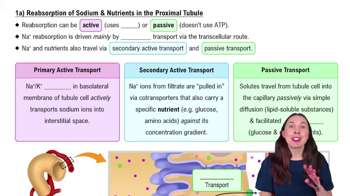
1a) Reabsorption of Sodium & Nutrients in the Proximal Tubule

Sodium Ion Exchange Mechanisms

Sodium ions are actively reabsorbed in the PCT via various transporters, often coupled with the secretion of other ions to maintain electrochemical balance. This exchange helps regulate acid-base balance and electrolyte homeostasis. Key secreted ions in exchange for sodium include hydrogen and ammonium ions.
Recommended video:
01:55
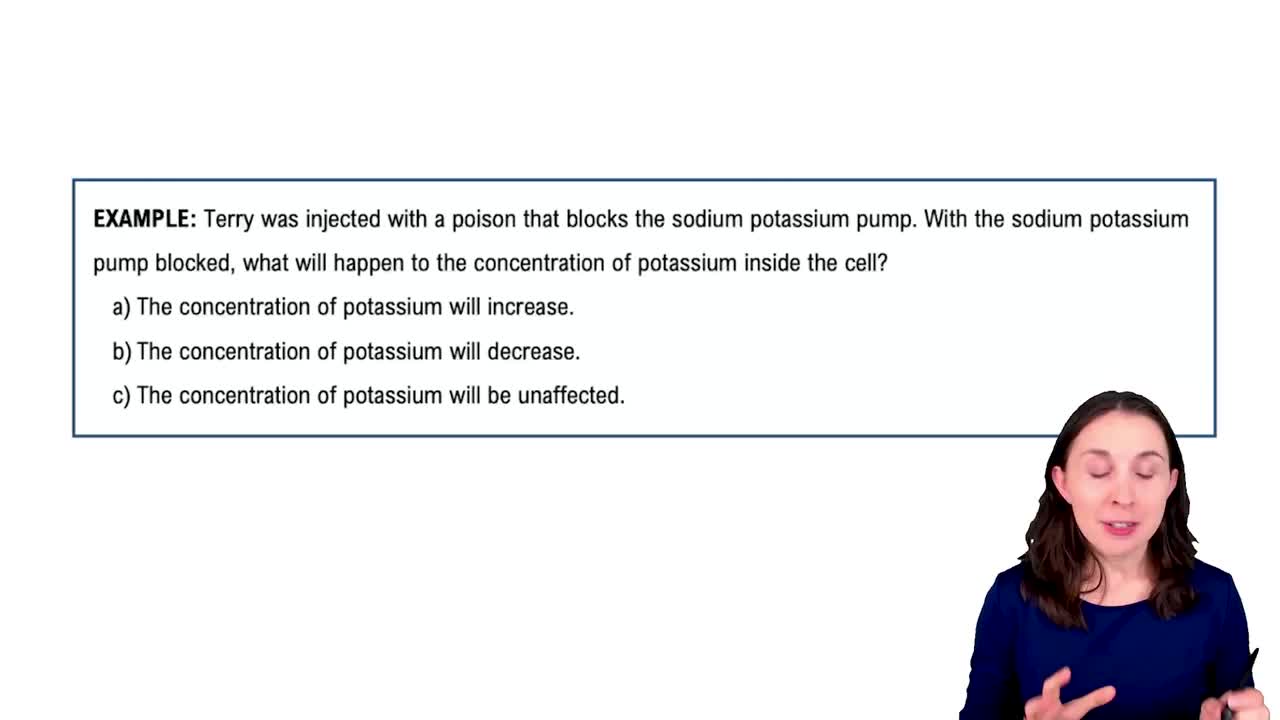
Ions - Sodium and Potassium Example 3

Secretion of Hydrogen and Ammonium Ions

Hydrogen ions (H⁺) and ammonium ions (NH4⁺) are secreted into the PCT lumen in exchange for sodium to help regulate blood pH and eliminate nitrogenous waste. This process involves antiporters that swap sodium ions from the tubular fluid with these secreted ions, contributing to acid-base balance and detoxification.
Recommended video:
05:03
Hydrogen Bonding