Ch. 21 The Immune System: Innate and Adaptive Body Defenses
Marieb - Human Anatomy & Physiology 11th Edition
Marieb, Hoehn11th EditionHuman Anatomy & PhysiologyISBN: 9780136874034Not the one you use?Change textbook
Chapter 21, Problem 25

Although the adaptive immune system has two arms, it has been said, 'no T cells, no immunity.' Explain.

Verified step by step guidance
1
Step 1: Understand the role of the adaptive immune system, which consists of two main components: B cells (humoral immunity) and T cells (cell-mediated immunity). Both work together to provide a specific immune response against pathogens.
Step 2: Recognize that T cells are crucial for activating and regulating the immune response. Helper T cells (CD4+ T cells) assist in activating B cells to produce antibodies and also help activate cytotoxic T cells (CD8+ T cells) to kill infected cells.
Step 3: Note that without T cells, B cells cannot be properly activated to produce effective antibodies, and cytotoxic T cells cannot eliminate infected or abnormal cells, leading to a severely compromised immune response.
Step 4: Understand that T cells also help in the formation of immunological memory, which is essential for long-lasting immunity and faster response upon re-exposure to the same pathogen.
Step 5: Conclude that the phrase 'no T cells, no immunity' emphasizes the indispensable role of T cells in orchestrating and sustaining the adaptive immune response, making them essential for effective immunity.

Verified video answer for a similar problem:

This video solution was recommended by our tutors as helpful for the problem above.
Video duration:
2m

Key Concepts

Here are the essential concepts you must grasp in order to answer the question correctly.

Adaptive Immune System Arms

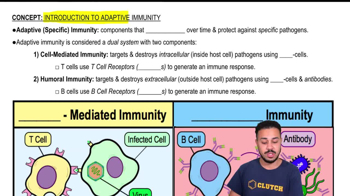
The adaptive immune system consists of two main components: humoral immunity, mediated by B cells producing antibodies, and cell-mediated immunity, driven by T cells. Both arms work together to recognize and eliminate specific pathogens, providing long-lasting immunity.
Recommended video:
Guided course
5:47
Adaptive Immunity

Role of T Cells in Immunity

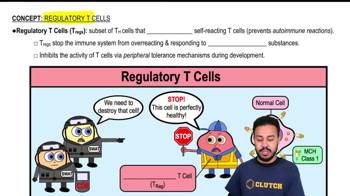
T cells are crucial for orchestrating the immune response; helper T cells activate B cells and other immune cells, while cytotoxic T cells directly kill infected or abnormal cells. Without T cells, the immune system cannot effectively coordinate or execute targeted responses.
Recommended video:
Guided course
3:53
Regulatory T Cells

Interdependence of T Cells and B Cells

B cells require signals from helper T cells to fully activate and produce high-affinity antibodies. This interdependence means that without T cells, B cells cannot mount an effective antibody response, leading to compromised adaptive immunity.
Recommended video:
Guided course
3:53
Regulatory T Cells