Ch. 16 The Endocrine System
Marieb - Human Anatomy & Physiology 11th Edition
Marieb, Hoehn11th EditionHuman Anatomy & PhysiologyISBN: 9780136874034Not the one you use?Change textbook
Chapter 16, Problem 25

Kyle, a 5-year-old boy, has been growing by leaps and bounds; his height is 100% above normal for his age. He has been complaining of headaches and vision problems. A CT scan reveals a large pituitary tumor.
(a) Which hormone is being secreted in excess?
(b) What condition will Kyle exhibit if corrective measures are not taken?
(c) What is the probable cause of his headaches and visual problems?

Verified step by step guidance
1
Step 1: Understand the role of the pituitary gland and its hormones. The pituitary gland secretes several hormones that regulate growth, including Growth Hormone (GH), which stimulates growth in children.
Step 2: Analyze the symptoms and findings. Kyle's height is 100% above normal for his age, indicating excessive growth hormone secretion. Therefore, the hormone secreted in excess is Growth Hormone (GH).
Step 3: Identify the condition caused by excess growth hormone in a child. Excess GH before the closure of growth plates leads to gigantism, characterized by abnormal height and size.
Step 4: Consider the cause of headaches and vision problems. A large pituitary tumor can compress nearby structures, especially the optic chiasm, leading to visual disturbances and headaches due to increased pressure.
Step 5: Summarize the answers: (a) Excess Growth Hormone (GH), (b) Gigantism if untreated, and (c) Compression of the optic chiasm and surrounding brain tissue by the tumor causing headaches and vision problems.

Verified video answer for a similar problem:

This video solution was recommended by our tutors as helpful for the problem above.
Video duration:
1m
Was this helpful?

Key Concepts

Here are the essential concepts you must grasp in order to answer the question correctly.

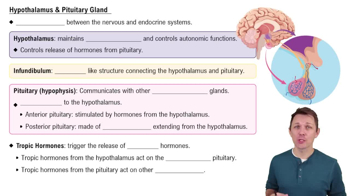
Pituitary Gland and Hormone Secretion

The pituitary gland is a small endocrine organ that regulates growth and other vital functions by secreting hormones. A tumor in the pituitary can cause excessive secretion of growth hormone (GH), leading to abnormal growth patterns. Understanding the role of GH is essential to identify the hormone involved in Kyle's condition.
Recommended video:
Guided course
7:10
Hypothalamus & Pituitary Gland

Gigantism and Its Clinical Features

Gigantism occurs when excess growth hormone is secreted before the closure of growth plates in children, causing abnormal height and size. Without treatment, symptoms include excessive growth, headaches, and vision problems. Recognizing gigantism helps explain Kyle's symptoms and the consequences of untreated hormone imbalance.
Recommended video:
4:08
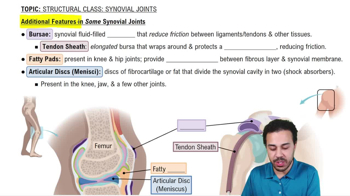
Additional Features

Effects of Pituitary Tumor on Surrounding Structures

A large pituitary tumor can compress nearby structures such as the optic chiasm, leading to headaches and visual disturbances. This explains Kyle's neurological symptoms and highlights the importance of tumor size and location in clinical presentation.
Recommended video:
Guided course
3:02
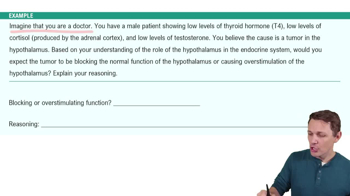
The Hypothalamus and Pituitary Gland Example 2
Related Practice
Textbook Question

Mary Morgan has just been brought into the emergency room of City General Hospital. She is perspiring profusely and is breathing rapidly and irregularly. Her breath smells like acetone (sweet and fruity), and her blood glucose tests out at 650 mg/100 ml of blood. She is in acidosis. Which hormone drug should be administered, and why?

2
views
Textbook Question

How are the hyperglycemia and lipidemia of insulin deficiency linked?

1
views
Textbook Question

List some problems that elderly people might have as a result of decreasing hormone production.

6
views
Textbook Question

Aaron, a 42-year-old single father, goes to his physician complaining of nausea and chronic fatigue. He reports having felt fatigued and listless for about half a year, but he had attributed this to stress. He has lost considerable weight and, strangely, his skin looks tanned, even though he spends long hours at work and rarely ventures outside. His doctor finds very low blood pressure and a rapid, weak pulse. Blood tests show that Aaron does not have anemia, but his plasma glucose, cortisol, and Na⁺ are low, and his plasma K⁺ is high. His doctor orders an ACTH stimulation test, in which Aaron's secretion of cortisol is measured after he is given a synthetic form of ACTH.

(a) What would account for Aaron's low plasma Na⁺ and high plasma K⁺ ?

(b) What is the reason for doing an ACTH stimulation test?

(c) Which gland is primarily affected if ACTH does not cause a normal elevation of cortisol secretion? What is this abnormality called?

(d) Which gland is primarily affected if ACTH does cause an elevation of cortisol secretion?

1
views