Ch. 14 The Autonomic Nervous System
Marieb - Human Anatomy & Physiology 11th Edition
Marieb, Hoehn11th EditionHuman Anatomy & PhysiologyISBN: 9780136874034Not the one you use?Change textbook
Chapter 14, Problem 2b

Relate each of the following terms or phrases to either the sympathetic (S) or parasympathetic (P) division of the autonomic nervous system: 
______ (7) Generally short-duration action 
______ (8) Increases heart rate and blood pressure 
______ (9) Increases gastric motility and secretion of lacrimal, salivary, and digestive juices 
______ (10) Innervates blood vessels 
______ (11) Most active when you are relaxing in a hammock 
______ (12) Active when you are running in the Boston Marathon

Verified step by step guidance
1
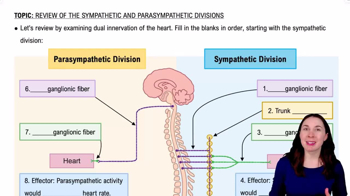
Step 1: Understand the two divisions of the autonomic nervous system: the sympathetic (S) division, which is responsible for the 'fight or flight' response, and the parasympathetic (P) division, which is responsible for the 'rest and digest' response.
Step 2: Relate the term 'generally short-duration action' to the sympathetic (S) division, as its effects are typically brief and designed for immediate response.
Step 3: Relate the term 'increases heart rate and blood pressure' to the sympathetic (S) division, as it prepares the body for action during stressful situations.
Step 4: Relate the term 'increases gastric motility and secretion of lacrimal, salivary, and digestive juices' to the parasympathetic (P) division, as it promotes digestion and relaxation processes.
Step 5: Relate the term 'innervates blood vessels' to the sympathetic (S) division, as it controls vasoconstriction and vasodilation, and the terms 'most active when you are relaxing in a hammock' and 'active when you are running in the Boston Marathon' to the parasympathetic (P) and sympathetic (S) divisions respectively, based on their roles in relaxation and physical exertion.

Verified video answer for a similar problem:

This video solution was recommended by our tutors as helpful for the problem above.
Video duration:
2m
Was this helpful?

Key Concepts

Here are the essential concepts you must grasp in order to answer the question correctly.

Sympathetic Division

The sympathetic division of the autonomic nervous system is responsible for the body's 'fight or flight' response. It prepares the body for stressful or emergency situations by increasing heart rate, blood pressure, and redirecting blood flow to essential organs and muscles. This division typically produces short-duration actions, allowing for quick responses to immediate threats.
Recommended video:
4:39
Review of the Sympathetic and Parasympathetic Divisions

Parasympathetic Division

The parasympathetic division is often referred to as the 'rest and digest' system. It promotes relaxation and conservation of energy by slowing the heart rate, increasing gastric motility, and stimulating the secretion of digestive juices. This division is most active during restful states, such as when a person is relaxing, and it counteracts the effects of the sympathetic division.
Recommended video:
4:39
Review of the Sympathetic and Parasympathetic Divisions

Autonomic Nervous System

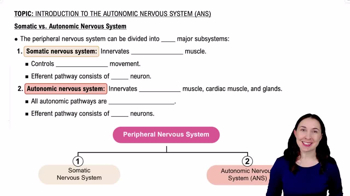
The autonomic nervous system (ANS) regulates involuntary physiological functions, including heart rate, blood pressure, respiration, and digestion. It is divided into two main branches: the sympathetic and parasympathetic divisions, which work in opposition to maintain homeostasis. Understanding the roles of these divisions is crucial for analyzing how the body responds to different stimuli and conditions.
Recommended video:
1:50
Somatic vs. Autonomic Nervous System