Ch. 14 The Autonomic Nervous System
Marieb - Human Anatomy & Physiology 11th Edition
Marieb, Hoehn11th EditionHuman Anatomy & PhysiologyISBN: 9780136874034Not the one you use?Change textbook
Chapter 14, Problem 2a

Relate each of the following terms or phrases to either the sympathetic (S) or parasympathetic (P) division of the autonomic nervous system: 
______ (1) Short preganglionic, long postganglionic fibers 
______ (2) Intramural ganglia 
______ (3) Craniosacral part 
______ (4) Adrenergic fibers 
______ (5) Cervical ganglia 
______ (6) Otic and ciliary ganglia

Verified step by step guidance
1
Step 1: Understand the basic anatomical and functional differences between the sympathetic (S) and parasympathetic (P) divisions of the autonomic nervous system. The sympathetic division typically has short preganglionic fibers and long postganglionic fibers, while the parasympathetic division has long preganglionic fibers and short postganglionic fibers.
Step 2: For the term 'Short preganglionic, long postganglionic fibers,' identify which division matches this description. Recall that the sympathetic division is characterized by short preganglionic and long postganglionic fibers.
Step 3: For 'Intramural ganglia,' recognize that these ganglia are located within or very close to the target organ walls, a hallmark of the parasympathetic division.
Step 4: 'Craniosacral part' refers to the origin of the parasympathetic division, which arises from the brainstem (cranial nerves) and sacral spinal cord segments, distinguishing it from the thoracolumbar origin of the sympathetic division.
Step 5: 'Adrenergic fibers' release norepinephrine as their neurotransmitter and are typically associated with the sympathetic division, whereas parasympathetic fibers are cholinergic (release acetylcholine).

Verified video answer for a similar problem:

This video solution was recommended by our tutors as helpful for the problem above.
Video duration:
3m
Was this helpful?

Key Concepts

Here are the essential concepts you must grasp in order to answer the question correctly.

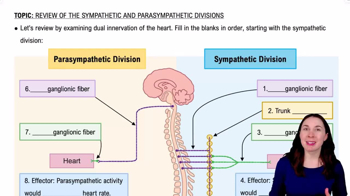
Sympathetic and Parasympathetic Divisions of the Autonomic Nervous System

The autonomic nervous system has two main divisions: sympathetic and parasympathetic. The sympathetic division prepares the body for 'fight or flight' responses, while the parasympathetic division supports 'rest and digest' activities. Each division has distinct anatomical and functional characteristics that influence organ function differently.
Recommended video:
4:39
Review of the Sympathetic and Parasympathetic Divisions

Preganglionic and Postganglionic Fiber Lengths

Preganglionic fibers originate in the central nervous system and synapse in autonomic ganglia, where they connect to postganglionic fibers that reach target organs. In the sympathetic division, preganglionic fibers are typically short and postganglionic fibers are long, whereas in the parasympathetic division, preganglionic fibers are long and postganglionic fibers are short.
Recommended video:
Guided course
7:47
The Muscle Fiber

Types and Locations of Autonomic Ganglia

Autonomic ganglia are clusters of nerve cell bodies where preganglionic neurons synapse with postganglionic neurons. Sympathetic ganglia include paravertebral (e.g., cervical) and prevertebral ganglia, while parasympathetic ganglia are often intramural (within or near target organs) or specific named ganglia like otic and ciliary ganglia.
Recommended video:
3:49
Sensory Receptor Classification by Location