
Textbook Question
Explain how the cerebellum is physically connected to the brain stem.

 Verified step by step guidance
 4:49
4:49
 0:43
0:43 2:31
2:31Explain how the cerebellum is physically connected to the brain stem.
Describe the stages of sleep and outline the order in which we progress through these stages during a typical night's sleep
a. Make a rough drawing of the lateral aspect of the left cerebral hemisphere.
b. You may be thinking, 'But I just can't draw!' So, name the hemisphere involved with most people's ability to draw.
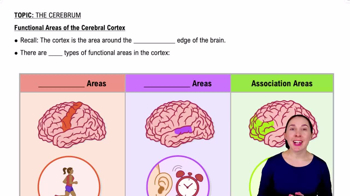
c. On your drawing, locate the following areas and provide the major function of each: primary motor cortex, premotor cortex, somatosensory association cortex, primary somatosensory cortex, visual and auditory areas, prefrontal cortex, Wernicke's and Broca's areas.
All of the following descriptions refer to dorsal column–medial lemniscal ascending pathways except one:
a. They include the fasciculus gracilis and fasciculus cuneatus.
b. They include a chain of three neurons.
c. Their connections are diffuse and poorly localized.
d. They are concerned with precise transmission of one or a few related types of sensory input.
A number of brain structures are listed below. If an area is primarily gray matter, write a in the answer blank; if mostly white matter, respond with b.
________ (1) cerebral cortex
________ (2) corpus callosum and corona radiata
________ (3) red nucleus
________ (4) medial and lateral nuclear groups
________ (5) medial lemniscus
________ (6) cranial nerve nuclei
________ (7) spinothalamic tract
________ (8) fornix
________ (9) cingulate and precentral gyri
A patient has suffered a cerebral hemorrhage that has caused dysfunction of the precentral gyrus of his right cerebral cortex. As a result:
a. He cannot voluntarily move his left arm or leg.
b. He feels no sensation on the left side of his body.
c. He feels no sensation on his right side.