Ch. 12 The Central Nervous System
Marieb - Human Anatomy & Physiology 11th Edition
Marieb, Hoehn11th EditionHuman Anatomy & PhysiologyISBN: 9780136874034Not the one you use?Change textbook
Chapter 12, Problem 13

A number of brain structures are listed below. If an area is primarily gray matter, write a in the answer blank; if mostly white matter, respond with b
________  (1) cerebral cortex 
________   (2) corpus callosum and corona radiata 
________   (3) red nucleus 
________   (4) medial and lateral nuclear groups 
________   (5) medial lemniscus 
________   (6) cranial nerve nuclei 
________   (7) spinothalamic tract 
________   (8) fornix 
________  (9) cingulate and precentral gyri

Verified step by step guidance
1
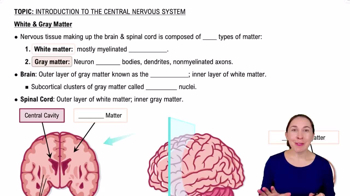
Step 1: Understand the difference between gray matter and white matter. Gray matter primarily contains neuronal cell bodies, dendrites, and unmyelinated axons, while white matter consists mostly of myelinated axons that form tracts connecting different brain regions.
Step 2: Identify the cerebral cortex (1) and the cingulate and precentral gyri (9) as parts of the brain's outer layer composed mainly of neuronal cell bodies, so these are primarily gray matter (answer 'a').
Step 3: Recognize that the corpus callosum and corona radiata (2) are large bundles of myelinated axons connecting different brain areas, classifying them as white matter (answer 'b').
Step 4: For structures like the red nucleus (3), medial and lateral nuclear groups (4), and cranial nerve nuclei (6), note that these are clusters of neuron cell bodies within the brain, so they are gray matter (answer 'a').
Step 5: Identify the medial lemniscus (5), spinothalamic tract (7), and fornix (8) as fiber tracts composed of myelinated axons, which means they are white matter (answer 'b').

Verified video answer for a similar problem:

This video solution was recommended by our tutors as helpful for the problem above.
Video duration:
6m
Was this helpful?

Key Concepts

Here are the essential concepts you must grasp in order to answer the question correctly.

Gray Matter

Gray matter consists mainly of neuronal cell bodies, dendrites, and unmyelinated axons. It is involved in processing and interpreting information in the brain. Structures like the cerebral cortex and cranial nerve nuclei are primarily gray matter, responsible for functions such as sensory perception and motor control.
Recommended video:
2:41
White & Gray Matter

White Matter

White matter is composed mostly of myelinated axons that connect different gray matter areas, facilitating communication within the brain and spinal cord. Examples include the corpus callosum and medial lemniscus, which act as pathways transmitting signals between brain regions.
Recommended video:
2:41
White & Gray Matter

Brain Structures and Their Composition

Different brain structures vary in their composition of gray or white matter. For instance, nuclei (like the red nucleus and medial/lateral nuclear groups) are clusters of gray matter, while tracts (such as the spinothalamic tract and fornix) are bundles of white matter. Understanding these distinctions helps classify brain areas correctly.
Recommended video:
7:49
Composition of Blood
Related Practice
Textbook Question

a. Make a rough drawing of the lateral aspect of the left cerebral hemisphere.

b. You may be thinking, 'But I just can't draw!' So, name the hemisphere involved with most people's ability to draw.

c. On your drawing, locate the following areas and provide the major function of each: primary motor cortex, premotor cortex, somatosensory association cortex, primary somatosensory cortex, visual and auditory areas, prefrontal cortex, Wernicke's and Broca's areas.

2
views
Textbook Question

All of the following descriptions refer to dorsal column–medial lemniscal ascending pathways except one:

a. They include the fasciculus gracilis and fasciculus cuneatus.

b. They include a chain of three neurons.

c. Their connections are diffuse and poorly localized.

d. They are concerned with precise transmission of one or a few related types of sensory input.

3
views
Textbook Question

What constitutes the blood brain barrier?

Textbook Question

List four ways in which the CNS is protected.

Textbook Question

A patient has suffered a cerebral hemorrhage that has caused dysfunction of the precentral gyrus of his right cerebral cortex. As a result:

a. He cannot voluntarily move his left arm or leg.

b. He feels no sensation on the left side of his body.

c. He feels no sensation on his right side.

2
views
Textbook Question

a. What is the advantage of having a cerebrum that is highly convoluted?

b. What term is used to indicate its grooves? Its outward folds?

c. Which groove divides the cerebrum into two hemispheres?

d. What divides the parietal from the frontal lobe? The parietal from the temporal lobe?

2
views