
Textbook Question
A fascicle is a:
a. Muscle
b. Bundle of muscle fibers enclosed by a connective tissue sheath
c. Bundle of myofibrils
d. Group of myofilaments
3
views

 Verified step by step guidance
 3:55
3:55
 03:53
03:53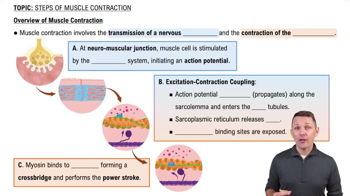 4:53
4:53A fascicle is a:
a. Muscle
b. Bundle of muscle fibers enclosed by a connective tissue sheath
c. Bundle of myofibrils
d. Group of myofilaments
The connective tissue covering that encloses the sarcolemma of an individual muscle fiber is called the:
a. Epimysium
b. Perimysium
c. Endomysium
d. Periosteum
The sites where the motor nerve impulse is transmitted from the nerve endings to the skeletal muscle cell membranes are the
a. neuromuscular junctions
b. sarcomeres
c. myofilaments
d. Z discs
A smooth, sustained contraction resulting from very rapid stimulation of the muscle, in which no evidence of relaxation is seen, is called:
a. A twitch
b. Temporal summation
c. Multiple motor unit summation
d. Fused tetanus
Thick and thin myofilaments have different compositions. For each descriptive phrase, indicate whether the filament is, a. thick or b. thin.
_____ (1) contains actin
_____ (2) contains ATPases
_____ (3) attaches to the Z disc
_____ (4) contains myosin
_____ (5) contains troponin
_____ (6) does not lie in the I band
Contraction elicited by a single brief stimulus is called:
a. A twitch
b. Temporal summation
c. Multiple motor unit summation
d. Fused tetanus