Ch. 6 Bones and Skeletal Tissues
Hoehn - Marieb Human Anatomy & Physiology, 12th edition
Hoehn, Haynes, Abbott12th EditionMarieb Human Anatomy & PhysiologyISBN: 9780138242732Not the one you use?Change textbook
Chapter 6, Problem 19

Compare and contrast controls of bone remodeling exerted by hormones and by mechanical and gravitational forces, including the purpose of each control system and changes in bone architecture that might occur.

Verified step by step guidance
1
Begin by defining bone remodeling as the continuous process where old bone tissue is replaced by new bone tissue, which is essential for maintaining bone strength and mineral homeostasis.
Explain the hormonal control of bone remodeling, focusing on key hormones such as parathyroid hormone (PTH), calcitonin, and sex hormones (estrogen and testosterone). Describe how PTH increases bone resorption to raise blood calcium levels, while calcitonin inhibits resorption to lower calcium levels. Also, note how sex hormones promote bone formation and help maintain bone density.
Describe the mechanical and gravitational control of bone remodeling, emphasizing Wolff's Law, which states that bone adapts to the mechanical stresses placed upon it. Explain how increased mechanical load stimulates osteoblast activity to strengthen bone, while lack of mechanical stress (e.g., in microgravity or immobilization) leads to bone resorption and weakening.
Compare the purposes of these control systems: hormonal control primarily regulates mineral balance and systemic calcium homeostasis, whereas mechanical control optimizes bone architecture to withstand physical forces and maintain skeletal integrity.
Discuss the changes in bone architecture resulting from each control system: hormonal imbalances can lead to conditions like osteoporosis or hypercalcemia, altering bone density and strength; mechanical unloading causes bone thinning and loss of trabecular connectivity, while mechanical loading enhances cortical thickness and trabecular density.

Verified video answer for a similar problem:

This video solution was recommended by our tutors as helpful for the problem above.
Video duration:
2m
Was this helpful?

Key Concepts

Here are the essential concepts you must grasp in order to answer the question correctly.

Hormonal Regulation of Bone Remodeling

Hormones such as parathyroid hormone, calcitonin, and sex steroids regulate bone remodeling by controlling osteoclast and osteoblast activity. This system maintains calcium homeostasis and adapts bone mass to metabolic needs, influencing bone resorption and formation to keep mineral balance.
Recommended video:
Guided course
13:06
Review of Major Hormones

Mechanical and Gravitational Forces in Bone Remodeling

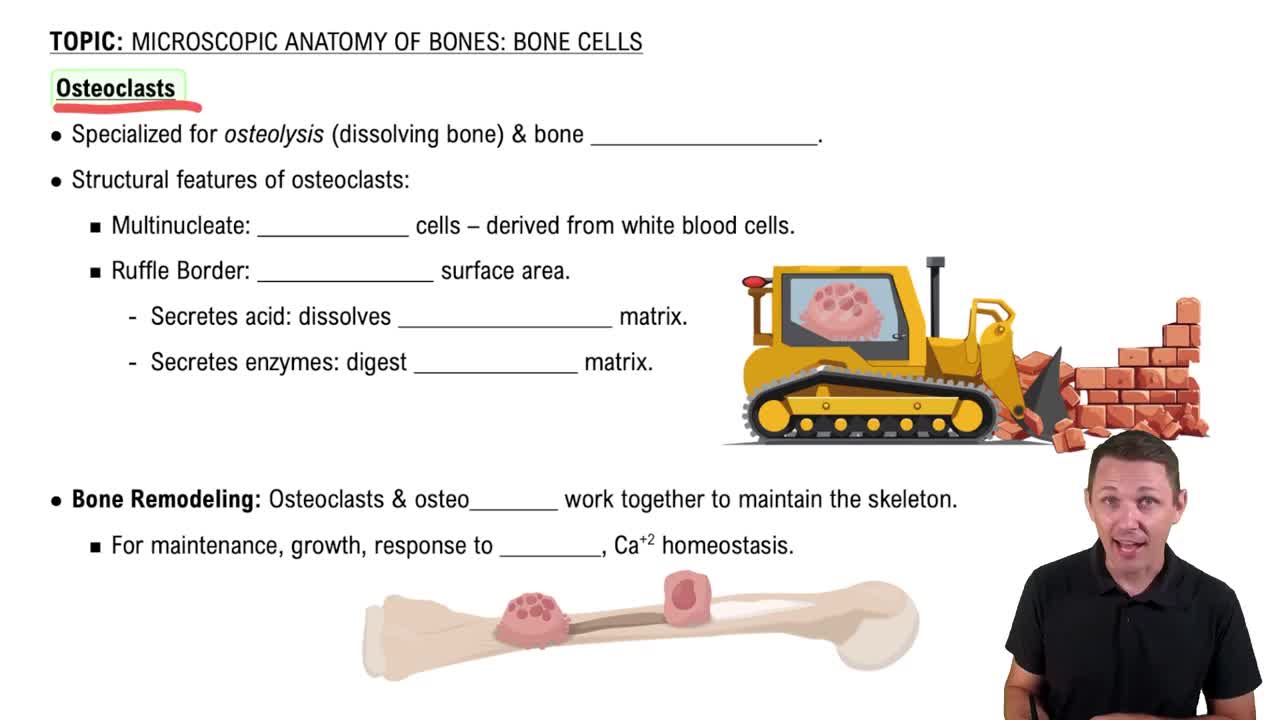
Mechanical loading and gravitational forces stimulate bone remodeling through mechanotransduction, where osteocytes sense strain and signal for bone formation or resorption. This adaptive response strengthens bone architecture in areas experiencing higher stress, optimizing structural integrity.
Recommended video:

Changes in Bone Architecture Due to Remodeling Controls

Hormonal and mechanical controls lead to distinct changes in bone structure: hormones adjust overall bone density and mineral content, while mechanical forces shape bone geometry and trabecular orientation. Together, these systems ensure bones are both metabolically balanced and mechanically efficient.
Recommended video:
3:35
Review of Relevant Brain Anatomy
Related Practice
Textbook Question

Compare bone to cartilage tissue relative to its resilience, speed of regeneration, and access to nutrients.

7
views

Textbook Question

Noah Beckenstein went to weight-lifting camp in the summer between seventh and eighth grade. He noticed that the camp trainer put tremendous pressure on him and his friends to improve their strength. After an especially vigorous workout, Noah's arm felt extremely sore and weak around the elbow. He went to the camp doctor, who took X rays and then told him that the injury was serious, for the 'end of his upper arm bone was starting to twist off.' What had happened? Could the same thing happen to Noah's 23-year-old sister, Karen, who was also starting a program of weight lifting? Why or why not?

4
views
Textbook Question

Mrs. Abbruzzo brought her 4-year-old daughter to the doctor, complaining that she didn't 'look right.' The child's forehead was enlarged, her rib cage was knobby, and her lower limbs were bent and deformed. X rays revealed very thick epiphyseal plates. Mrs. Abbruzzo was advised to increase dietary amounts of vitamin D and milk and to get the girl outside to play in the sun. Considering the child's signs and symptoms, what disease do you think she has? Explain the doctor's instructions.

2
views
Textbook Question

What would a long bone look like at the end of adolescence if bone remodeling did not occur?

2
views
Textbook Question

Why do you think wheelchair-bound people with paralyzed lower limbs have thin, weak bones of the leg and thigh?

1
views
Textbook Question

Yolanda is asked to review a bone slide that her professor has set up under the microscope. She sees concentric layers surrounding a central cavity. Is this bone section taken from the diaphysis or the epiphyseal plate of the specimen?

2
views