Ch. 6 Bones and Skeletal Tissues
Hoehn - Marieb Human Anatomy & Physiology, 12th edition
Hoehn, Haynes, Abbott12th EditionMarieb Human Anatomy & PhysiologyISBN: 9780138242732Not the one you use?Change textbook
Chapter 6, Problem 15

a. Why are fractures most common in elderly individuals?
b. Why are greenstick fractures most common in children?

Verified step by step guidance
1
Step 1: Understand the structural changes in bones with aging. In elderly individuals, bones undergo a decrease in bone density and mineral content, a condition known as osteoporosis, which makes bones more brittle and prone to fractures.
Step 2: Recognize that elderly bones have reduced collagen and calcium, leading to decreased bone strength and elasticity, which increases the likelihood of fractures even with minor trauma.
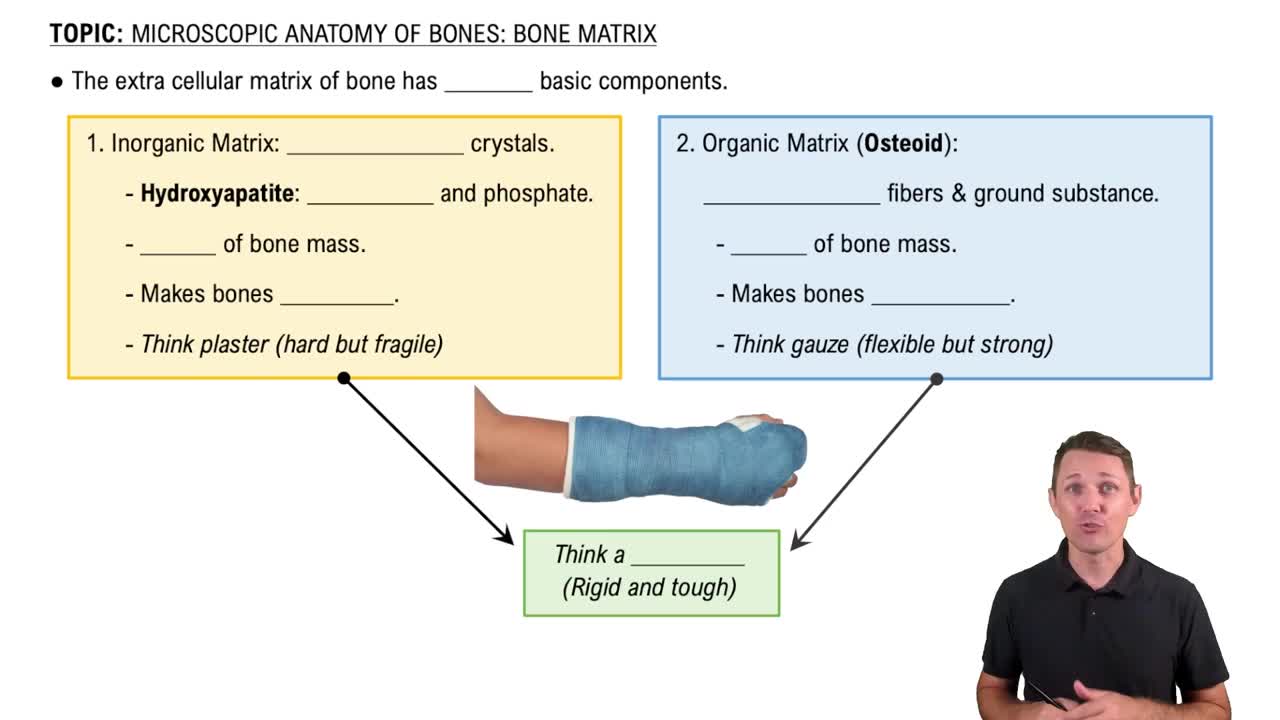
Step 3: For children, understand that their bones are still developing and contain more organic matrix (collagen) and less mineralization, making them more flexible and less brittle compared to adult bones.
Step 4: Learn that greenstick fractures occur in children because their bones are softer and more pliable, so instead of breaking completely, the bone bends and cracks partially, similar to how a green twig breaks.
Step 5: Summarize that fractures are more common in elderly due to bone brittleness from decreased density, while greenstick fractures are common in children due to the flexibility and incomplete ossification of their bones.

Verified video answer for a similar problem:

This video solution was recommended by our tutors as helpful for the problem above.
Video duration:
2m
Was this helpful?

Key Concepts

Here are the essential concepts you must grasp in order to answer the question correctly.

Bone Density and Aging

As people age, bone density decreases due to reduced calcium absorption and hormonal changes, leading to osteoporosis. This makes bones more brittle and prone to fractures, especially in elderly individuals.
Recommended video:
04:10
Density of Liquid Water vs. Solid Ice

Bone Flexibility in Children

Children's bones contain more collagen and have a higher water content, making them more flexible and less brittle. This flexibility allows bones to bend rather than break completely, resulting in greenstick fractures.
Recommended video:

Types of Fractures

Fractures vary based on bone properties and force applied. In elderly, brittle bones often cause complete breaks, while in children, flexible bones lead to partial breaks like greenstick fractures, where the bone bends and cracks without breaking fully.
Recommended video:
3:00
Types-Of-Phosphorylation-C-2-V-1