Ch. 2 Chemistry Comes Alive
Hoehn - Marieb Human Anatomy & Physiology, 12th edition
Hoehn, Haynes, Abbott12th EditionMarieb Human Anatomy & PhysiologyISBN: 9780138242732Not the one you use?Change textbook
Chapter 2, Problem 5

In a beaker of water, the water-water bonds can properly be called:
a. Ionic bonds
b. Polar covalent bonds
c. Nonpolar covalent bonds
d. Hydrogen bonds

Verified step by step guidance
1
Step 1: Understand the types of bonds mentioned in the options. Ionic bonds involve the transfer of electrons between atoms, polar covalent bonds involve unequal sharing of electrons within a molecule, nonpolar covalent bonds involve equal sharing of electrons, and hydrogen bonds are weak attractions between a hydrogen atom in one molecule and an electronegative atom in another molecule.
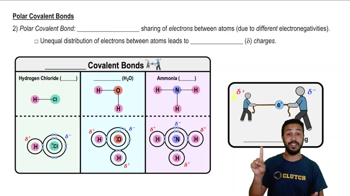
Step 2: Recognize that within a single water molecule (H₂O), the oxygen and hydrogen atoms are connected by polar covalent bonds because oxygen is more electronegative and pulls electrons closer, creating partial charges.
Step 3: Identify that the question asks about water-water bonds, meaning the interactions between different water molecules, not within a single molecule.
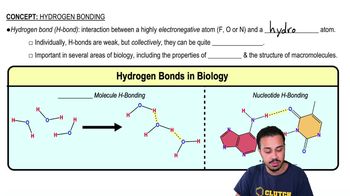
Step 4: Recall that water molecules interact with each other through hydrogen bonds, which are weak attractions between the hydrogen atom of one water molecule and the oxygen atom of another water molecule.
Step 5: Conclude that the correct term for the bonds between water molecules in a beaker of water is hydrogen bonds.

Verified video answer for a similar problem:

This video solution was recommended by our tutors as helpful for the problem above.
Video duration:
2m
Was this helpful?

Key Concepts

Here are the essential concepts you must grasp in order to answer the question correctly.

Hydrogen Bonds

Hydrogen bonds are weak attractions between a hydrogen atom covalently bonded to an electronegative atom (like oxygen) and another electronegative atom nearby. In water, these bonds form between the hydrogen of one molecule and the oxygen of another, giving water its unique properties.
Recommended video:
05:03
Hydrogen Bonding

Polar Covalent Bonds

Polar covalent bonds occur when two atoms share electrons unequally due to differences in electronegativity. In a water molecule, the oxygen and hydrogen atoms share electrons unevenly, making the molecule polar with partial positive and negative charges.
Recommended video:
06:59
Polar Covalent Bonds

Ionic vs Covalent Bonds

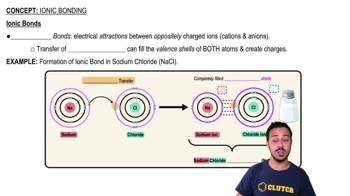
Ionic bonds involve the transfer of electrons between atoms, creating charged ions, while covalent bonds involve sharing electrons. Water molecules are held together internally by polar covalent bonds, not ionic bonds, and the interactions between molecules are hydrogen bonds.
Recommended video:
06:07
Ionic Bonds