Ch. 18 The Cardiovascular System: The Heart
Hoehn - Marieb Human Anatomy & Physiology, 12th edition
Hoehn, Haynes, Abbott12th EditionMarieb Human Anatomy & PhysiologyISBN: 9780138242732Not the one you use?Change textbook
Chapter 18, Problem 4

The sequence of contraction of the heart chambers is:
a. Random
b. Left chambers followed by right chambers
c. Both atria followed by both ventricles
d. Right atrium, right ventricle, left atrium, left ventricle

Verified step by step guidance
1
Understand the basic physiology of the heart's conduction system, which controls the sequence of contraction in the heart chambers.
Recall that the sinoatrial (SA) node initiates the electrical impulse, causing both atria to contract almost simultaneously.
Recognize that after atrial contraction, the impulse travels to the atrioventricular (AV) node, then through the bundle of His and Purkinje fibers, leading to ventricular contraction.
Note that both ventricles contract nearly at the same time following atrial contraction to efficiently pump blood to the lungs and the rest of the body.
Conclude that the correct sequence is both atria contracting first, followed by both ventricles contracting together.

Verified video answer for a similar problem:

This video solution was recommended by our tutors as helpful for the problem above.
Video duration:
2m
Was this helpful?

Key Concepts

Here are the essential concepts you must grasp in order to answer the question correctly.

Cardiac Cycle

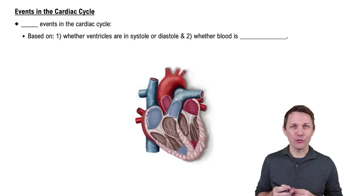
The cardiac cycle refers to the sequence of events in one heartbeat, including contraction (systole) and relaxation (diastole) of the heart chambers. Understanding this cycle is essential to know how blood flows through the heart and the timing of chamber contractions.
Recommended video:
Guided course
9:44
Events in the Cardiac Cycle

Atrial and Ventricular Contraction Sequence

The heart contracts in a coordinated manner where both atria contract first to push blood into the ventricles, followed by the contraction of both ventricles to pump blood out to the lungs and body. This sequence ensures efficient blood flow and prevents backflow.
Recommended video:
Guided course
4:53
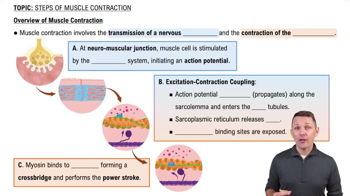
Overview of Muscle Contraction

Electrical Conduction System of the Heart

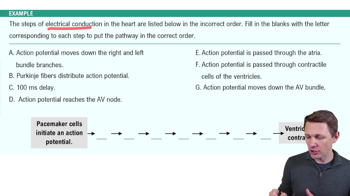
The heart's contraction sequence is controlled by its electrical conduction system, starting at the sinoatrial (SA) node, causing atrial contraction, then passing to the atrioventricular (AV) node and Purkinje fibers to trigger ventricular contraction. This system ensures the proper timing of chamber contractions.
Recommended video:
Guided course
3:42
Electrical Conduction System of the Heart Example 2
Related Practice
Textbook Question

The portion of the intrinsic conduction system located in the superior interventricular septum is the:

a. AV node

b. SA node

c. AV bundle

d. Subendocardial conducting network

1
views
Textbook Question

When the semilunar valves are open, which of the following are occurring?

(1) Coronary arteries fill

(2) AV valves are closed

(3) Ventricles are in systole

(4) Ventricles are in diastole

(5) Blood enters the aorta

(6) Blood enters pulmonary arteries

(7) Atria contract

a. 2, 3, 5, 6

b. 1, 2, 3, 7

c. 1, 3, 5, 6

d. 2, 4, 5, 7

1
views
Textbook Question

The cardiac term that refers to the volume of blood remaining in a ventricle after contraction is

(a) end diastolic volume,

(b) end systolic volume,

(c) stroke volume,

(d) cardiac reserve.

1
views
Textbook Question

In the heart, which of the following apply?

(1) Action potentials are conducted from cell to cell across the myocardium via gap junctions

(2) The SA node sets the pace for the heart as a whole

(3) Spontaneous depolarization of cardiac cells can occur in the absence of nerve stimulation

(4) Cardiac muscle can continue to contract for long periods in the absence of oxygen

a. All of the above

b. 1, 3, 4

c. 1, 2, 3

d. 2, 3

1
views
Textbook Question

An ECG provides information about:

a. Cardiac output

b. Movement of the excitation wave across the heart

c. Coronary circulation

d. Valve impairment

1
views
Textbook Question

Select the anatomical or physiological feature that correctly describes cardiac muscle and not skeletal muscle.

(a) striations appear as alternating light and dark bands,

(b) intercalated discs connect adjacent muscle cells,

(c) sarcoplasmic reticulum stores and releases calcium ions,

(d) calcium ions bind troponin to signal contraction

1
views