Ch. 17 Blood
Hoehn - Marieb Human Anatomy & Physiology, 12th edition
Hoehn, Haynes, Abbott12th EditionMarieb Human Anatomy & PhysiologyISBN: 9780138242732Not the one you use?Change textbook
Chapter 17, Problem 19

How is clot overgrowth usually prevented?
List two conditions that may lead to unnecessary (and undesirable) clot formation.

Verified step by step guidance
1
Understand that clot overgrowth is usually prevented by natural anticoagulant mechanisms in the body that regulate clot formation and dissolution to maintain blood flow and prevent excessive clotting.
Recognize that one key mechanism involves the release of substances like prostacyclin and nitric oxide from endothelial cells, which inhibit platelet aggregation and vasodilate blood vessels, reducing clot formation.
Another important factor is the presence of anticoagulant proteins such as antithrombin III and activated protein C, which inactivate clotting factors and limit the clotting cascade.
For the second part, identify conditions that can lead to unnecessary clot formation, such as endothelial injury (damage to the blood vessel lining) which exposes collagen and triggers clotting.
Also consider conditions like stasis of blood flow (slow or turbulent blood flow), which can promote clot formation by allowing platelets and clotting factors to accumulate and activate.

Verified video answer for a similar problem:

This video solution was recommended by our tutors as helpful for the problem above.
Video duration:
5m
Was this helpful?

Key Concepts

Here are the essential concepts you must grasp in order to answer the question correctly.

Mechanisms Preventing Clot Overgrowth

Clot overgrowth is typically prevented by natural anticoagulant systems such as antithrombin, protein C and S pathways, and fibrinolysis. These mechanisms regulate clot size by inhibiting excessive thrombin generation and breaking down fibrin, ensuring clots remain localized and do not obstruct normal blood flow.
Recommended video:
10:05
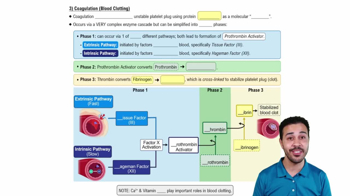
Coagulation (Blood Clotting)

Pathophysiology of Thrombosis

Thrombosis occurs when clots form inappropriately within blood vessels, disrupting normal circulation. It involves an imbalance between procoagulant and anticoagulant factors, often triggered by endothelial injury, abnormal blood flow, or hypercoagulability, leading to pathological clot formation.

Conditions Leading to Unnecessary Clot Formation

Two common conditions that promote unwanted clotting are atherosclerosis, where damaged vessel walls trigger clotting, and atrial fibrillation, which causes blood stasis in the heart. Both increase the risk of thrombosis by creating environments conducive to clot initiation and growth.
Recommended video:
4:28
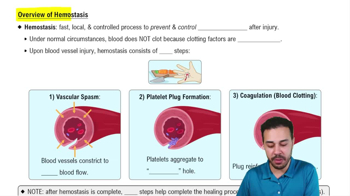
Overview of Hemostasis