
Local anesthetics block voltage-gated Na⁺ channels. General anesthetics are thought to activate chemically gated Cl⁻ channels, thereby rendering the nervous system quiescent while surgery is performed. What specific process do anesthetics impair, and how does this interfere with nerve impulse transmission?
Ch. 11 Fundamentals of the Nervous System and Nervous Tissue
Hoehn, Haynes, Abbott12th EditionMarieb Human Anatomy & PhysiologyISBN: 9780138242732Not the one you use?Change textbook
All textbooks
Hoehn, Haynes, Abbott 12th Edition
Ch. 11 Fundamentals of the Nervous System and Nervous Tissue
Problem 23
Hoehn, Haynes, Abbott 12th Edition
Ch. 11 Fundamentals of the Nervous System and Nervous Tissue
Problem 23Chapter 11, Problem 23
When admitted to the emergency room, Sean was holding his right hand, which had a deep puncture hole in its palm. He explained that he had fallen on a nail while exploring a barn. Sean was given an antitetanus shot to prevent neural complications. Tetanus bacteria fester in deep, dark wounds, but how do their toxins travel in neural tissue?
Verified step by step guidance1
Understand that tetanus bacteria produce a toxin called tetanospasmin, which affects the nervous system by interfering with neurotransmitter release.
Recognize that the toxin does not travel freely in the bloodstream but instead moves within the nervous system by retrograde axonal transport.
Recall that retrograde axonal transport is a process where substances are carried from the nerve endings back toward the cell body along the axon, using motor proteins like dynein.
Apply this knowledge to the scenario: the tetanus toxin enters peripheral motor neurons at the wound site and travels backward along the axon to the central nervous system (spinal cord and brainstem).
Conclude that this mode of transport allows the toxin to reach inhibitory interneurons in the CNS, leading to the characteristic muscle spasms and rigidity seen in tetanus.

Verified video answer for a similar problem:
This video solution was recommended by our tutors as helpful for the problem above.
Video duration:
2mWas this helpful?
Key Concepts
Here are the essential concepts you must grasp in order to answer the question correctly.
Tetanus Bacteria and Toxin Production
Clostridium tetani bacteria thrive in deep, anaerobic wounds like punctures. They produce tetanospasmin, a potent neurotoxin responsible for the symptoms of tetanus. Understanding the bacteria's environment and toxin production is key to grasping the infection's progression.
Recommended video:
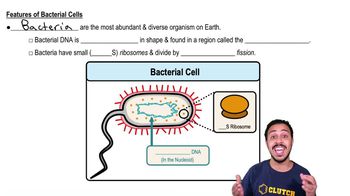
Features of Bacterial Cells
Neural Pathways for Toxin Transport
Tetanospasmin travels from the wound site to the central nervous system by binding to peripheral nerve terminals. It moves retrogradely along motor neurons via axonal transport, bypassing the bloodstream, to reach inhibitory interneurons in the spinal cord and brainstem.
Recommended video:
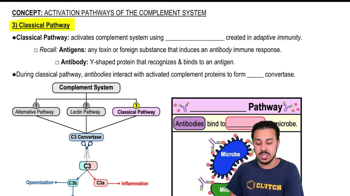
Classical Pathway
Mechanism of Tetanus Neurotoxicity
Once in the central nervous system, tetanospasmin blocks the release of inhibitory neurotransmitters like GABA and glycine. This leads to uncontrolled muscle contractions and spasms characteristic of tetanus. The toxin’s neural transport and action explain the clinical symptoms.
Recommended video:
Internal Regulation - The Myogenic Mechanism
Related Practice
Textbook Question
1
views
Textbook Question
Rochelle developed multiple sclerosis when she was 27. After eight years she had lost a good portion of her ability to control her skeletal muscles. How did this happen?
1
views
Textbook Question
The effects of neurotransmitter binding are very brief. Explain.
1
views
Textbook Question
Describe the events that must occur to generate an AP. Relate the sequence of changes in permeability to changes in the ion channels, and explain why the AP is an all-or-none phenomenon.
3
views
Textbook Question
What is the polarized membrane state? How is it maintained? (Note the relative roles of both passive and active mechanisms.)
5
views
Textbook Question
Explain both the anatomical and functional divisions of the nervous system. Include the subdivisions of each.