Ch. 10 The Muscular System
Hoehn - Marieb Human Anatomy & Physiology, 12th edition
Hoehn, Haynes, Abbott12th EditionMarieb Human Anatomy & PhysiologyISBN: 9780138242732Not the one you use?Change textbook
Chapter 10, Problem 2

The arrangement of muscle fibers in which the fibers are arranged at an angle to a central longitudinal tendon is:
a. Circular
b. Longitudinal
c. Pennate
d. Parallel

Verified step by step guidance
1
Step 1: Understand the different types of muscle fiber arrangements. Muscle fibers can be arranged in various patterns, each affecting the muscle's function and force generation.
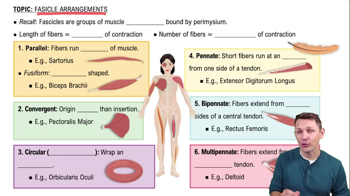
Step 2: Define the options given: Circular muscles have fibers arranged in concentric rings; Longitudinal muscles have fibers running parallel to the long axis; Parallel muscles also have fibers running parallel but may differ in shape; Pennate muscles have fibers arranged at an angle to a central tendon.
Step 3: Focus on the key phrase 'fibers are arranged at an angle to a central longitudinal tendon.' This describes a muscle where fibers do not run straight along the tendon but insert obliquely.
Step 4: Recall that pennate muscles are characterized by fibers that attach obliquely to a central tendon, allowing for greater force production due to more fibers packed into a given area.
Step 5: Conclude that the correct arrangement described is 'Pennate' because it matches the description of fibers arranged at an angle to a central tendon.

Verified video answer for a similar problem:

This video solution was recommended by our tutors as helpful for the problem above.
Video duration:
2m
Was this helpful?

Key Concepts

Here are the essential concepts you must grasp in order to answer the question correctly.

Muscle Fiber Arrangement

Muscle fibers can be arranged in different patterns relative to the tendon, affecting the muscle's function and force generation. Understanding these arrangements helps identify how muscles contract and produce movement.
Recommended video:
Guided course
8:11
Fascicle Arrangements

Pennate Muscle Structure

Pennate muscles have fibers that are oriented at an angle to a central tendon, resembling a feather. This arrangement allows for a greater number of fibers in a given area, increasing force production but reducing the range of motion.
Recommended video:
Guided course
3:04
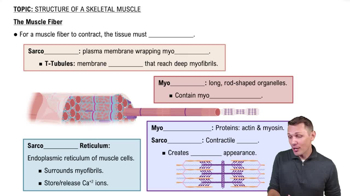
Structure of a Skeletal Muscle Example 1

Comparison of Muscle Fiber Types

Different muscle fiber arrangements include circular, longitudinal, parallel, and pennate. Each type has unique structural features and functional roles, such as circular muscles controlling openings and longitudinal muscles facilitating long-range contractions.
Recommended video:
Guided course
7:47
The Muscle Fiber