Ch. 10 The Muscular System
Hoehn - Marieb Human Anatomy & Physiology, 12th edition
Hoehn, Haynes, Abbott12th EditionMarieb Human Anatomy & PhysiologyISBN: 9780138242732Not the one you use?Change textbook
Chapter 10, Problem 3

Match the muscle names in column B to the facial muscles described in column A.
Column A 
______ (1) squints the eyes 
______ (2) raises the eyebrows 
______ (3) smiling muscle 
______ (4) puckers the lips 
______ (5) pulls the scalp posteriorly
Column B
a. corrugator supercilii
b. depressor anguli oris
c. frontal belly of epicranius
d. occipital belly of epicranius
e. orbicularis oculi
f. orbicularis oris
g. zygomaticus

Verified step by step guidance
1
Step 1: Identify the muscle responsible for squinting the eyes. The orbicularis oculi muscle encircles the eye and is primarily responsible for closing the eyelids tightly, which is what happens when you squint.
Step 2: Determine which muscle raises the eyebrows. The frontal belly of the epicranius (also called the frontalis) elevates the eyebrows and wrinkles the forehead.
Step 3: Find the muscle known as the 'smiling muscle.' The zygomaticus muscle pulls the corners of the mouth upward and outward, producing a smile.
Step 4: Identify the muscle that puckers the lips. The orbicularis oris muscle encircles the mouth and controls movements like puckering or pursing the lips.
Step 5: Match the muscle that pulls the scalp posteriorly. The occipital belly of the epicranius pulls the scalp backward, complementing the action of the frontal belly.

Verified video answer for a similar problem:

This video solution was recommended by our tutors as helpful for the problem above.
Video duration:
2m
Was this helpful?

Key Concepts

Here are the essential concepts you must grasp in order to answer the question correctly.

Facial Muscle Functions

Understanding the specific actions of facial muscles is essential for matching their names to their functions. Each muscle controls distinct facial expressions, such as squinting, smiling, or puckering lips, by contracting in unique ways. Recognizing these functions helps in identifying the correct muscle based on the described movement.
Recommended video:
Guided course
6:30
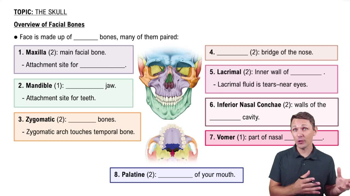
Overview of Facial Bones

Anatomical Location of Facial Muscles

Knowing where each facial muscle is located on the head aids in associating muscle names with their actions. For example, muscles around the eyes control eyelid movements, while those near the mouth influence expressions like smiling or puckering. This spatial awareness is crucial for accurate identification.
Recommended video:
Guided course
3:55
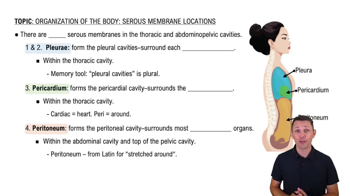
Locations of Serous Membranes

Epicranius Muscle Structure and Roles

The epicranius muscle has two parts: the frontal belly, which raises the eyebrows, and the occipital belly, which pulls the scalp posteriorly. Understanding this dual structure clarifies how different sections of the same muscle contribute to distinct facial movements, important for matching descriptions to muscle names.
Recommended video:
Guided course
3:04
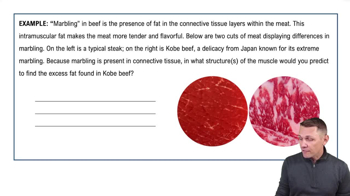
Structure of a Skeletal Muscle Example 1