Ch. 4 Histology
Amerman- Human Anatomy & Physiology 3e
Amerman3rd EditionHuman Anatomy & PhysiologyISBN: 9780138247201, 9780138247928, 9780138201814Not the one you use?Change textbook
Chapter 4, Problem 7b

Compare and contrast the following pairs of terms:
Unicellular gland and multicellular gland

Verified step by step guidance
1
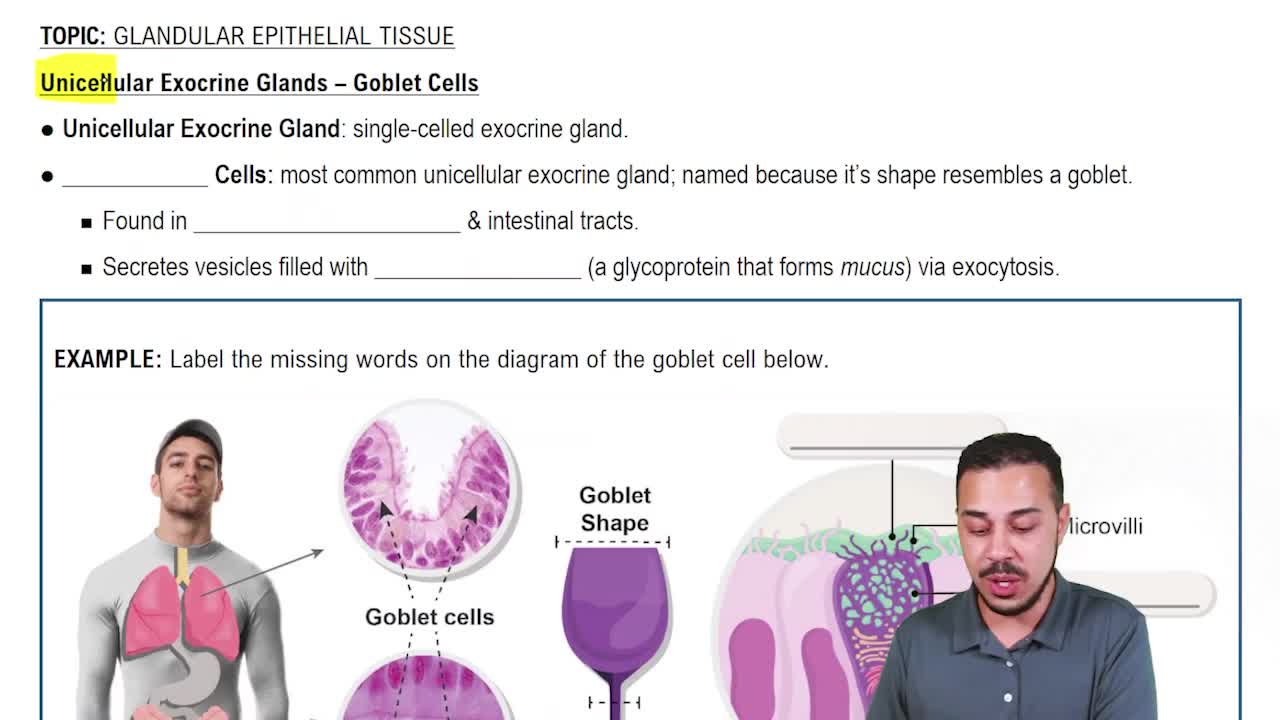
Define a unicellular gland: A unicellular gland is a single-celled gland that secretes substances directly onto a surface or into a lumen. An example is a goblet cell, which secretes mucus in the respiratory and digestive tracts.
Define a multicellular gland: A multicellular gland is composed of multiple cells that work together to produce and secrete substances. These glands can be further classified into simple (unbranched ducts) and compound (branched ducts) glands, such as sweat glands or salivary glands.
Compare the structure: Unicellular glands consist of a single cell, while multicellular glands are made up of multiple cells organized into a structure, such as tubular or alveolar shapes.
Compare the secretion process: Unicellular glands release their secretions directly onto the surface or into a lumen, whereas multicellular glands often use ducts to transport their secretions to the target site.
Contrast their locations and examples: Unicellular glands, like goblet cells, are typically found in epithelial linings, while multicellular glands, such as sebaceous glands or the pancreas, are more complex and found in various tissues and organs.

Verified video answer for a similar problem:

This video solution was recommended by our tutors as helpful for the problem above.
Was this helpful?

Key Concepts

Here are the essential concepts you must grasp in order to answer the question correctly.

Unicellular Glands

Unicellular glands consist of a single cell that performs the function of secretion. An example is the goblet cell, which secretes mucus in the respiratory and digestive tracts. These glands are typically found embedded within epithelial tissues and are responsible for localized secretion, playing a crucial role in protecting and lubricating surfaces.
Recommended video:
Guided course
04:39
Unicellular Exocrine Glands - Goblet Cells

Multicellular Glands

Multicellular glands are composed of multiple cells that work together to produce and secrete substances. They can be further classified into exocrine glands, which secrete their products into ducts, and endocrine glands, which release hormones directly into the bloodstream. Examples include salivary glands and the thyroid gland, respectively, highlighting their diverse functions in the body.
Recommended video:
Guided course
7:10
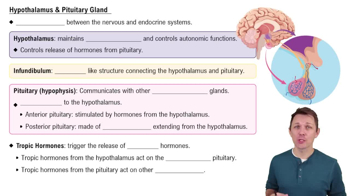
Hypothalamus & Pituitary Gland

Comparison of Gland Types

The primary difference between unicellular and multicellular glands lies in their structure and complexity. Unicellular glands are simpler and consist of a single cell, while multicellular glands are more complex, involving groups of cells organized into tissues. This structural difference influences their secretion mechanisms, functional roles, and the types of substances they produce, impacting overall physiological processes.
Recommended video:
Guided course
7:10
Hypothalamus & Pituitary Gland