
Ch. 3 The Cell
Amerman- Human Anatomy & Physiology 3e
Amerman3rd EditionHuman Anatomy & PhysiologyISBN: 9780138247201, 9780138247928, 9780138201814Not the one you use?Change textbook
Chapter 3, Problem 8

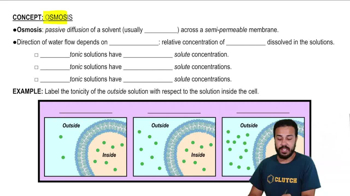
A hypotonic solution will cause water to move ________the cell, and the cell will ______.
A hypertonic solution will cause water to move ______the cell, and the cell will ________.

Verified step by step guidance
1
Understand the concept of tonicity: Tonicity refers to the relative concentration of solutes in a solution compared to the inside of a cell. A hypotonic solution has a lower solute concentration than the cell, while a hypertonic solution has a higher solute concentration than the cell.
Recall the principle of osmosis: Water moves across a semipermeable membrane from an area of lower solute concentration (higher water concentration) to an area of higher solute concentration (lower water concentration).
For a hypotonic solution: Since the solution has a lower solute concentration than the cell, water will move into the cell. This influx of water can cause the cell to swell and potentially burst (lyse) if the influx is excessive.
For a hypertonic solution: Since the solution has a higher solute concentration than the cell, water will move out of the cell. This efflux of water can cause the cell to shrink (crenate).
Summarize the effects: In a hypotonic solution, water moves into the cell, and the cell swells. In a hypertonic solution, water moves out of the cell, and the cell shrinks.

Verified video answer for a similar problem:

This video solution was recommended by our tutors as helpful for the problem above.
Video duration:
6m
Was this helpful?

Key Concepts

Here are the essential concepts you must grasp in order to answer the question correctly.

Osmosis

Osmosis is the movement of water molecules across a selectively permeable membrane from an area of lower solute concentration to an area of higher solute concentration. This process is crucial for maintaining cellular homeostasis and is driven by the concentration gradient of solutes.
Recommended video:
05:59
Osmosis

Hypotonic Solution

A hypotonic solution has a lower concentration of solutes compared to the inside of a cell. When a cell is placed in a hypotonic solution, water moves into the cell, causing it to swell and potentially burst due to increased internal pressure.
Recommended video:
02:19
Homogenous vs. Heterogenous Solutions

Hypertonic Solution

A hypertonic solution has a higher concentration of solutes than the inside of a cell. In this scenario, water moves out of the cell into the surrounding solution, leading to cell shrinkage or crenation as the cell loses water to balance the solute concentrations.
Recommended video:
02:19
Homogenous vs. Heterogenous Solutions
Related Practice
Textbook Question

Match the term with its appropriate definition. 

Osmosis    

Secondary active transport    

Exocytosis    

Phagocytosis    

Simple diffusion    

Primary active transport    

Pinocytosis    

Facilitated diffusion

a. Type of endocytosis in which a large particle is ingested

b. Transport across the plasma membrane against the concentration gradient via direct use of energy from ATP

c. Passive movement of solute across the plasma membrane

d. Movement of solvent from a solution of lower solute concentration to a solution of higher solute concentration

e. Passive movement of solute across the plasma membrane via a channel or carrier protein

f. Type of endocytosis in which ECF is brought into the cell in a protein-coated pit

g. Release of large substances from the cell through a vesicle

h. Transport of a substance across the plasma membrane against its concentration gradient using the energy from the 'downhill' movement of another substance

1
views
Textbook Question

Explain how the members of the endomembrane system interact.

1
views
Textbook Question

Match the following terms with the correct functions.

Peroxisome     

Ribosome     

Smooth endoplasmic reticulum     

Mitochondrion     

Golgi apparatus     

Lysosome     

Rough endoplasmic reticulum     

Vesicle

a. Modifies and folds proteins into the correct structure

b. Modifies, packages, and sorts proteins

c. Contains digestive enzymes

d. Granular organelle that makes proteins

e. Synthesizes most of a cell’s ATP

f. Contains enzymes that oxidize toxins and fatty acids

g. Membrane-enclosed structure used to transport substances through the cell

h. Detoxifies certain chemicals, makes lipids, stores calcium ions

Textbook Question

Mark the following statements about the plasma membrane as true or false. If a statement is false, correct it to make a true statement.

The overall structure of the plasma membrane is a mosaic with the components locked tightly in place.

1
views
Textbook Question

Mark the following statements about the cytoskeleton as true or false. If a statement is false, correct it to make a true statement.

Actin filaments combine with myosin motor proteins to provide the cell with mechanical strength.

5
views
Textbook Question

What is the primary difference between active transport processes and passive transport processes?

2
views