Ch. 3 The Cell
Amerman- Human Anatomy & Physiology 3e
Amerman3rd EditionHuman Anatomy & PhysiologyISBN: 9780138247201, 9780138247928, 9780138201814Not the one you use?Change textbook
Chapter 3, Problem L2.3d

Explain how the form of each of the following structures is related to its function:
Lysosomes

Verified step by step guidance
1
Lysosomes are membrane-bound organelles that contain hydrolytic enzymes. Their form, specifically the enclosing membrane, is crucial for isolating these enzymes from the rest of the cell to prevent damage to other cellular components.
The membrane of lysosomes is specialized to maintain an acidic environment (pH ~4.5-5) inside the organelle, which is optimal for the activity of the hydrolytic enzymes. This form ensures the enzymes function efficiently while protecting the cytoplasm from acidity.
The enzymes within lysosomes are designed to break down macromolecules such as proteins, lipids, carbohydrates, and nucleic acids. The spherical shape of lysosomes maximizes the internal volume for enzyme storage and substrate processing.
Lysosomes are small and mobile, allowing them to move throughout the cytoplasm and fuse with other organelles or vesicles, such as autophagosomes or endosomes, to digest cellular debris or foreign particles. Their form facilitates this dynamic interaction.
The lysosomal membrane contains transport proteins that allow the breakdown products (e.g., amino acids, sugars) to be exported back into the cytoplasm for reuse. This structural feature ensures efficient recycling of cellular materials.

Verified video answer for a similar problem:

This video solution was recommended by our tutors as helpful for the problem above.
Was this helpful?

Key Concepts

Here are the essential concepts you must grasp in order to answer the question correctly.

Lysosome Structure

Lysosomes are membrane-bound organelles that contain hydrolytic enzymes. Their spherical shape and single lipid bilayer membrane provide a stable environment for these enzymes to function optimally. The acidic interior of lysosomes is crucial for activating these enzymes, which are responsible for breaking down waste materials and cellular debris.
Recommended video:
05:38
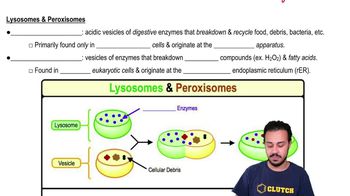
Lysosomes & Peroxisomes

Function of Lysosomes

Lysosomes play a vital role in cellular digestion and waste management. They break down macromolecules, such as proteins, lipids, and carbohydrates, into their monomeric units, which can then be reused by the cell. This process is essential for maintaining cellular homeostasis and recycling cellular components.
Recommended video:
05:38
Lysosomes & Peroxisomes

Relationship Between Structure and Function

The relationship between the structure and function of lysosomes is a prime example of how cellular components are adapted for specific roles. The unique structure of lysosomes, including their membrane and enzyme composition, directly supports their function in digestion and waste processing, illustrating the principle that form follows function in biological systems.
Recommended video:
6:40
Relationship Between Blood Flow, Pressure, & Resistance