Ch. 25 Fluid, Electrolyte, and Acid-Base Homeostasis
Amerman- Human Anatomy & Physiology 3e
Amerman3rd EditionHuman Anatomy & PhysiologyISBN: 9780138247201, 9780138247928, 9780138201814Not the one you use?Change textbook
Chapter 25, Problem 10b

Mark the following statements as true or false. If a statement is false, correct it to make a true statement.
b. Insulin, aldosterone, and epinephrine stimulate the uptake of potassium ions into cells.

Verified step by step guidance
1
Step 1: Understand the role of each hormone mentioned in the statement. Insulin, aldosterone, and epinephrine are hormones that influence various physiological processes, including ion regulation.
Step 2: Recall the specific function of insulin. Insulin promotes the uptake of glucose into cells and also facilitates the uptake of potassium ions (K⁺) into cells by stimulating the activity of the sodium-potassium pump.
Step 3: Examine the role of aldosterone. Aldosterone primarily regulates sodium (Na⁺) and potassium (K⁺) balance by acting on the kidneys, promoting sodium reabsorption and potassium excretion. It does not directly stimulate the uptake of potassium into cells.
Step 4: Analyze the role of epinephrine. Epinephrine can stimulate the uptake of potassium ions into cells by activating beta-adrenergic receptors, which enhance the activity of the sodium-potassium pump.
Step 5: Based on the above analysis, determine the accuracy of the statement. If the statement is false, correct it by specifying that aldosterone does not stimulate the uptake of potassium ions into cells but instead promotes potassium excretion in the kidneys.

Verified video answer for a similar problem:

This video solution was recommended by our tutors as helpful for the problem above.
Was this helpful?

Key Concepts

Here are the essential concepts you must grasp in order to answer the question correctly.

Insulin and Potassium Regulation

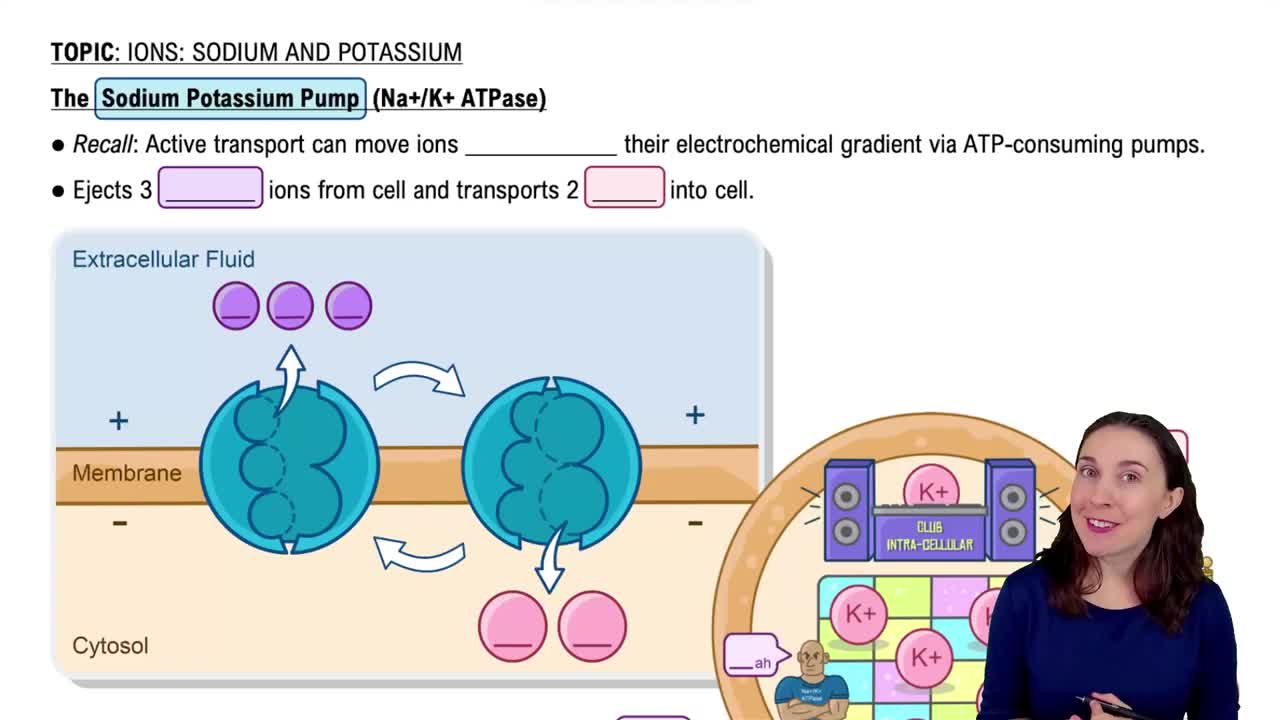
Insulin plays a crucial role in regulating blood glucose levels, but it also facilitates the uptake of potassium ions into cells. This occurs because insulin stimulates the Na+/K+ ATPase pump, which moves potassium into cells while transporting sodium out, thus lowering serum potassium levels.
Recommended video:
03:40
The Sodium Potassium Pump

Aldosterone and Electrolyte Balance

Aldosterone is a steroid hormone that regulates sodium and potassium levels in the body. It promotes sodium reabsorption and potassium excretion in the kidneys, leading to increased potassium levels in the blood. Therefore, while it affects potassium levels, it does not stimulate its uptake into cells.
Recommended video:
11:30
Renin-Angiotensin-Aldosterone-System

Epinephrine's Role in Metabolism

Epinephrine, also known as adrenaline, is a hormone that prepares the body for 'fight or flight' responses. It primarily increases blood glucose levels and can influence potassium levels by promoting the release of potassium from cells into the bloodstream, rather than stimulating its uptake.
Recommended video:
02:17
Introduction to Metabolism
Related Practice
Textbook Question

Mark the following statements as true or false. If a statement is false, correct it to make a true statement.

d. Hypocalcemia causes neurons to become hyperexcitable, leading to potential tetanic contractions.

6
views

Textbook Question

Mark the following statements as true or false. If a statement is false, correct it to make a true statement.

a. Potassium ions are responsible for the repolarization phase of the action potential.

2
views
Textbook Question

Which of the following effects tend to be caused by hypernatremia?

a. Inhibition of ADH secretion

b. Cellular crenation

c. Cellular swelling

d. Increased urine production

1
views
Textbook Question

Mark the following statements as true or false. If a statement is false, correct it to make a true statement.

c. Hyperkalemia tends to decrease the resting membrane potential and hyperpolarize excitable cells.

5
views
Textbook Question

Mark the following statements as true or false. If a statement is false, correct it to make a true statement.

e. Chloride ions are generally reabsorbed from the kidneys, along with bicarbonate ions.

1
views
Textbook Question

Which of the following statements best describes the principle of mass balance?

a. The amount of a variable that is gained by the body through ingestion equals the amount that is lost from the body.

b. The body maintains a stable mass at all times.

c. The amount of each variable brought into the body must be balanced by all other variables.

d. The amount of a variable ingested is regulated by a positive feedback loop.

1
views