Ch. 24 The Urinary System
Amerman- Human Anatomy & Physiology 3e
Amerman3rd EditionHuman Anatomy & PhysiologyISBN: 9780138247201, 9780138247928, 9780138201814Not the one you use?Change textbook
Chapter 24, Problem 2

Which of the following is not a physiological process carried out by the kidneys?
a. Blood pressure regulation
b. Tubular reabsorption
c. Tubular secretion
d. Glomerular filtration
e. All of the above are physiological processes carried out by the kidneys.

Verified step by step guidance
1
Step 1: Understand the role of the kidneys in the body. The kidneys are vital organs responsible for maintaining homeostasis by filtering blood, removing waste, and regulating various physiological processes.
Step 2: Review the listed processes: (a) Blood pressure regulation, (b) Tubular reabsorption, (c) Tubular secretion, (d) Glomerular filtration. Each of these terms refers to a specific function or process associated with kidney physiology.
Step 3: Define each term: (a) Blood pressure regulation involves the kidneys releasing hormones like renin to control blood pressure. (b) Tubular reabsorption is the process of reclaiming water and solutes from the filtrate back into the blood. (c) Tubular secretion is the active transport of substances from the blood into the tubular fluid. (d) Glomerular filtration is the process of filtering blood plasma through the glomerulus to form filtrate.
Step 4: Evaluate whether each process is indeed a physiological function of the kidneys. Cross-check each term with the known functions of the kidneys to determine if any listed process is not carried out by the kidneys.
Step 5: Conclude whether all the processes listed are physiological functions of the kidneys or if one of them does not belong. If all are valid, the answer would be 'e. All of the above are physiological processes carried out by the kidneys.'

Verified video answer for a similar problem:

This video solution was recommended by our tutors as helpful for the problem above.
Was this helpful?

Key Concepts

Here are the essential concepts you must grasp in order to answer the question correctly.

Kidney Functions

The kidneys perform several vital physiological functions, including the regulation of blood pressure, filtration of blood, and maintenance of electrolyte balance. They achieve this through processes such as glomerular filtration, tubular reabsorption, and tubular secretion, which collectively help in the formation of urine and the regulation of body fluids.
Recommended video:
1:00
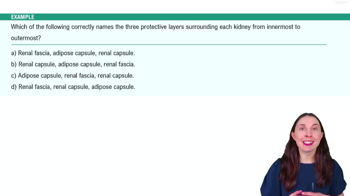
The Kidneys Example 1

Glomerular Filtration

Glomerular filtration is the first step in urine formation, where blood is filtered in the glomeruli of the kidneys. This process allows water, ions, and small molecules to pass into the renal tubules while retaining larger molecules like proteins and blood cells in the bloodstream, thus playing a crucial role in maintaining homeostasis.
Recommended video:
3:15
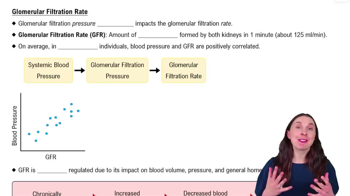
Glomerular Filtration Rate

Tubular Reabsorption and Secretion

Tubular reabsorption and secretion are processes that occur in the renal tubules after glomerular filtration. Reabsorption involves the movement of water and solutes from the tubular fluid back into the bloodstream, while secretion is the transfer of substances from the blood into the tubular fluid. Together, these processes help regulate the composition of blood and the volume of urine produced.
Recommended video:
4:06
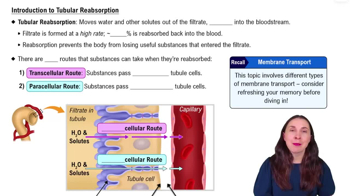
Introduction to Tubular Reabsorption