
Textbook Question
Explain the difference between an ionic and a covalent bond.

 Verified step by step guidance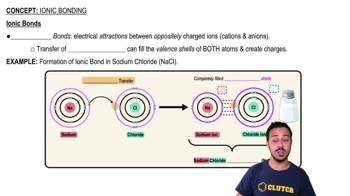
 06:07
06:07
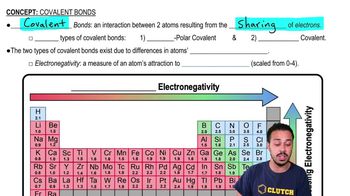 04:28
04:28 04:15
04:15Explain the difference between an ionic and a covalent bond.
Many drugs and poisons exert their effects by blocking one or more enzymes. How could blocking an enzyme lead to the death of a cell?
The polysaccharide cellulose is not digestible by humans, as we lack the enzyme cellulase, which is required to break it down. Certain dietary supplements contain the enzyme cellulase and claim that being able to break down cellulose will help a person lose weight. But what do you think would happen if we could digest the cellulose we ate?
What are hydrogen bonds, and how do they form?
Describe what takes place during a chemical reaction.
Match the following terms with the correct definition:
Endergonic reaction
Potential energy
Electrical energy
Anabolic reaction
Oxidation-reduction reaction
Chemical energy
Catabolic reaction
Kinetic energy
a. Energy in motion
b. Energy stored in chemical bonds
c. Reaction that consumes energy
d. A decomposition reaction
e. The energy of moving charged particles
f. Stored energy
g. Synthesis reaction
h. Reaction where electrons are transferred between reactants