Ch. 17 The Cardiovascular System I: The Heart
Amerman- Human Anatomy & Physiology 3e
Amerman3rd EditionHuman Anatomy & PhysiologyISBN: 9780138247201, 9780138247928, 9780138201814Not the one you use?Change textbook
Chapter 17, Problem 16

Cardiac output is equal to:
a. End-diastolic volume minus end-systolic volume.
b. Heart rate multiplied by stroke volume.
c. Stroke volume divided by end-diastolic volume.
d. Heart rate multiplied by preload.

Verified step by step guidance
1
Understand the concept of cardiac output: Cardiac output (CO) is the volume of blood the heart pumps per minute. It is a key measure of heart function and is influenced by heart rate (HR) and stroke volume (SV).
Recall the formula for cardiac output: CO = HR × SV. This formula indicates that cardiac output is calculated by multiplying the heart rate (beats per minute) by the stroke volume (amount of blood ejected per beat).
Review the definitions of stroke volume and heart rate: Stroke volume is the difference between end-diastolic volume (EDV) and end-systolic volume (ESV), which represents the amount of blood ejected during a single heartbeat. Heart rate is the number of heartbeats per minute.
Analyze the options provided in the problem: Option (b) correctly matches the formula for cardiac output (CO = HR × SV). Option (a) describes stroke volume (SV = EDV - ESV), not cardiac output. Option (c) involves dividing stroke volume by end-diastolic volume, which is not related to cardiac output. Option (d) incorrectly associates cardiac output with preload.
Conclude that the correct answer is based on the formula CO = HR × SV, which corresponds to option (b).

Verified video answer for a similar problem:

This video solution was recommended by our tutors as helpful for the problem above.
Was this helpful?

Key Concepts

Here are the essential concepts you must grasp in order to answer the question correctly.

Cardiac Output

Cardiac output (CO) is a critical physiological measure that represents the volume of blood the heart pumps per minute. It is calculated by multiplying heart rate (HR), the number of heartbeats per minute, by stroke volume (SV), the amount of blood ejected by the heart with each beat. Understanding CO is essential for assessing cardiovascular health and function.
Recommended video:
Guided course
9:44
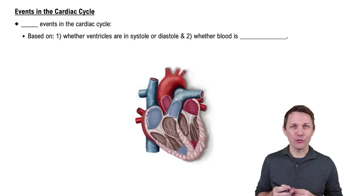
Events in the Cardiac Cycle

Heart Rate

Heart rate refers to the number of times the heart beats in one minute. It is a vital sign that can indicate the body's demand for oxygen and blood flow. Changes in heart rate can affect cardiac output, making it a key factor in understanding how efficiently the heart is functioning during various activities or states of health.
Recommended video:
Guided course
6:13
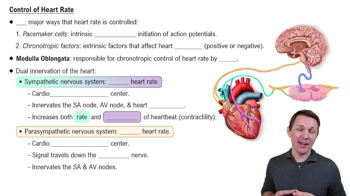
Control of Heart Rate

Stroke Volume

Stroke volume is the amount of blood pumped by the left ventricle of the heart in one contraction. It is influenced by factors such as preload, afterload, and contractility. Stroke volume, along with heart rate, directly determines cardiac output, making it crucial for evaluating heart performance and overall circulatory efficiency.
Recommended video:
Guided course
6:28
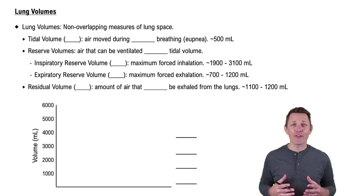
Lung Volumes
Related Practice
Textbook Question

An increase in preload causes a/an ________ in stroke volume in accordance with the ________ law. An increase in afterload causes a/an ________ in stroke volume. An increase in contractility causes a/an ________ in stroke volume.

2
views
Textbook Question

Mark the following statements as true or false. If a statement is false, correct it to make a true statement.

Tissue perfusion to the heart decreases during systole and increases during diastole.

1
views
Textbook Question

Which of the following statements is false?

a. The sympathetic nervous system releases epinephrine and norepinephrine, which are positive chronotropic and inotropic agents.

b. The endocrine system regulates cardiac output through chronotropic and inotropic hormones and through hormones that regulate water balance.

c. The parasympathetic nervous system releases acetylcholine and epinephrine, which are strongly negative inotropic agents.

d. Factors such as electrolyte concentrations, body temperature, and age all affect cardiac output.

2
views
Textbook Question

A birth defect called transposition of great vessels results in the pulmonary trunk emanating from the left ventricle and the aorta stemming from the right ventricle.

Which ventricle is thicker-walled, and why?

4
views
Textbook Question

The first heart sound is called ________ and it is caused by the closing of the ________ valves. It occurs at the beginning of the ________ phase of the cardiac cycle. The second heart sound is called ________ and it is caused by the closing of the ________ valves. It occurs at the beginning of the ________ phase of the cardiac cycle.

2
views
Textbook Question

Which chamber generates the highest pressure during systole?

a. Right atrium

b. Right ventricle

c. Left atrium

d. Left ventricle